

When you pick up a generic pill at the pharmacy, you expect it to work just like the brand-name version. But here’s something most people don’t realize: the studies that prove those generics are safe and effective were often done on a very narrow group of people-young, healthy men. That’s not just outdated; it’s scientifically risky. As drug use becomes more diverse, especially with aging populations and gender-specific medications, regulators are finally catching up. Bioequivalence studies must now account for age and sex, or we risk approving drugs that don’t work the same way for everyone.
Why Bioequivalence Studies Used to Ignore Women and Older Adults
For decades, bioequivalence (BE) studies followed a simple rule: use young, healthy male volunteers. The logic was straightforward. Men have fewer hormonal fluctuations, less body fat variation, and lower rates of pregnancy-related complications. They were seen as the most predictable group. And since BE studies rely on comparing how the body absorbs a drug from one formulation versus another, minimizing variability seemed smart. But this approach ignored a basic truth: men and women don’t process drugs the same way. Women often have slower gastric emptying, higher body fat percentages, and different levels of liver enzymes that break down medications. Older adults, meanwhile, experience reduced kidney function, lower muscle mass, and changes in stomach acidity-all of which affect how drugs are absorbed and cleared. The problem wasn’t just science. It was convenience. Recruiting women meant managing contraception requirements, dealing with menstrual cycle timing, and facing lower participation rates. Older adults were excluded because they often had other health conditions that could muddy the results. So, the system stayed stuck in the 1980s-even as more women and older people started taking these drugs.What Regulators Now Require for Age and Sex Representation
Today, the rules are changing. The U.S. Food and Drug Administration (FDA) updated its guidance in May 2023 to make it clear: if a drug is meant for both men and women, your bioequivalence study must include roughly equal numbers of each. That’s not a suggestion-it’s a requirement. The same goes for drugs targeting older adults. If your product is used by people over 60, you need to include them in the study-or give a solid scientific reason why you didn’t. The European Medicines Agency (EMA) takes a slightly different tone. Their 2010 guideline says subjects “could belong to either sex,” but doesn’t require balance. Still, they expect researchers to design studies that can detect differences between formulations, even if the group isn’t perfectly representative. Brazil’s ANVISA is stricter: studies must have equal male-female distribution, and participants must be between 18 and 50 years old, with no smoking and a BMI within normal limits. Here’s the key difference: the FDA now wants studies to reflect the real-world patient population. The EMA still prioritizes sensitivity-can we detect a difference between the two drug versions? But even the EMA is under pressure to change. A 2022 review by their Scientific Advice Working Party signaled that updates to their guidelines are coming in 2024.Why Sex Differences Matter More Than You Think
It’s not just about fairness. It’s about safety and effectiveness. Take levothyroxine, a common thyroid medication. Over 60% of users are women. But in many bioequivalence studies for this drug, women made up less than 25% of participants. That’s a huge mismatch. Women metabolize this drug differently due to estrogen levels, body weight, and even iron status. If a generic version is tested only on men, it might be approved even if it doesn’t deliver the same blood levels in women. A 2017 study showed a dramatic example. In a small trial with only 14 participants, a generic drug appeared bioinequivalent in men (79% absorption) but perfectly equivalent in women (95% absorption). At first glance, it looked like the drug failed in men. But when the same study was repeated with 36 participants, the results evened out. The initial finding was a statistical fluke caused by too few people. That’s why regulators now push for larger studies-typically 24 to 36 participants-to avoid these misleading results. Another issue: women tend to have higher variability in how they absorb drugs. That doesn’t mean they’re unpredictable-it means studies need enough women to capture that variability. If you only test 3 women out of 12 total subjects, you’re not seeing the full picture. You’re just getting lucky-or unlucky-with who you happen to pick.
Age Isn’t Just a Number-It’s a Pharmacokinetic Factor
Older adults aren’t just “older versions” of young people. Their bodies change. Kidneys slow down. Liver enzymes decline. Gut absorption shifts. These aren’t minor tweaks-they can alter how much drug gets into the bloodstream and how fast it leaves. Take digoxin, a heart medication. Older patients often need lower doses because their kidneys can’t clear it as quickly. If a bioequivalence study for a generic digoxin only includes 25-year-olds, you might miss that the generic version clears too slowly in seniors. That could lead to dangerous buildup in older patients. The FDA now requires that if a drug is intended for elderly patients, at least some participants in the BE study must be 60 or older. If you don’t include them, you need to prove why it’s not necessary-like if the drug is metabolized entirely by the liver and age doesn’t affect liver function for that specific compound. ANVISA’s rule limiting participants to under 50 is an outlier. Most experts agree that’s too restrictive. Many chronic medications are used primarily by people over 65. Excluding them from BE studies doesn’t protect safety-it just delays the discovery of real problems.Practical Challenges in Recruiting Diverse Participants
Changing the rules is one thing. Following them is another. Recruiting equal numbers of men and women costs 20-30% more. Why? Women are less likely to volunteer for clinical trials. They juggle childcare, work, and family responsibilities. Many sites don’t offer flexible hours or childcare support. Some women are hesitant due to past unethical research practices. Sponsors also struggle with older participants. They may have multiple medications, making it harder to isolate the effects of the test drug. They’re more likely to drop out due to health issues. That means you need to enroll more people upfront to end up with enough evaluable subjects. To fix this, some companies are getting creative. They’re partnering with senior centers, offering transportation, and using targeted outreach through women’s health clinics. One CRO reported a 40% longer recruitment time for gender-balanced studies-but they also saw fewer dropouts and more reliable data. The bigger issue? Most studies still don’t analyze results by sex or age group. They just pool everyone together. That’s like testing a car on flat roads and assuming it handles hills the same way. You need subgroup analysis-looking at how the drug behaves in men versus women, under 50 versus over 60-to truly understand if the formulations are equivalent across populations.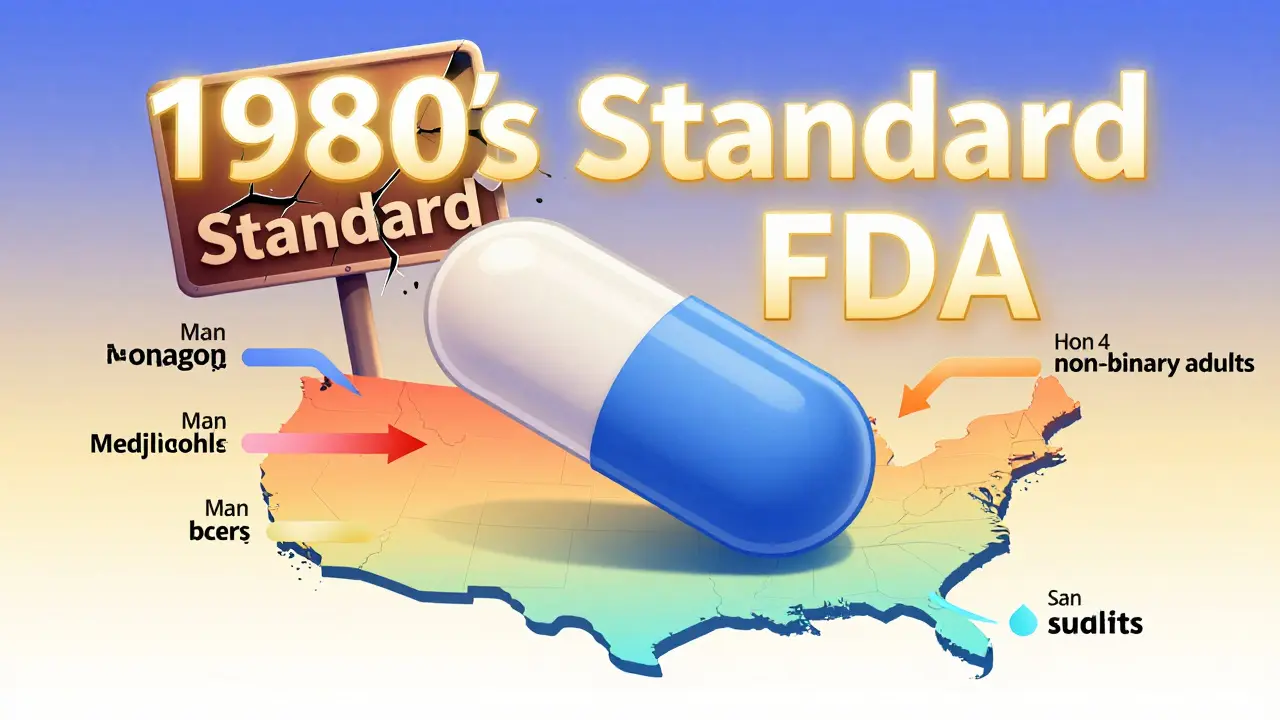
What Happens When You Ignore These Factors
The consequences aren’t theoretical. In 2019, a generic version of a blood thinner was approved based on a BE study with 90% male participants. Within months, reports came in of increased bleeding episodes in older women. The manufacturer had to issue a safety alert. The FDA later found that the generic version had a slower absorption rate in women over 65-something the original study missed because it had only three women over 60. These aren’t rare cases. A 2021 FDA analysis of 1,200 generic drug applications found that only 38% achieved a female participation rate between 40% and 60%. The median was just 32%. That’s not just a gap-it’s a blind spot. And it’s not just about safety. It’s about trust. If patients-especially women and older adults-feel like the system doesn’t consider them, they’re less likely to take their meds as prescribed. That leads to worse outcomes, higher hospitalization rates, and more costs down the line.The Future: More Inclusive, More Accurate
The tide is turning. The FDA’s 2023 draft guidance is the clearest signal yet: bioequivalence studies must reflect the real patients who will use the drug. The National Academies of Sciences, Engineering, and Medicine recommended in 2021 that sex-specific bioequivalence criteria be developed for narrow therapeutic index drugs-medications like warfarin, lithium, and digoxin, where small differences can be dangerous. New research is also revealing how big the sex differences really are. A 2023 University of Toronto study found that 37% of commonly tested drugs are cleared 15-22% faster in men than in women. That’s not a small variation-it’s clinically significant. The future of bioequivalence isn’t about one-size-fits-all. It’s about understanding how drugs behave across different bodies. That means better study designs. More diverse recruitment. Transparent reporting. And most importantly, recognizing that a drug that works for a 25-year-old man might not work the same way for a 70-year-old woman.Frequently Asked Questions
Why are bioequivalence studies often done only on young men?
Historically, young, healthy men were chosen because they were seen as the most predictable group. Fewer hormonal fluctuations, lower risk of pregnancy, and less medication interference made them easier to study. But this practice ignored biological differences in women and older adults, leading to gaps in safety and effectiveness data for real-world users.
Do regulatory agencies require equal numbers of men and women in bioequivalence studies?
The U.S. FDA now requires similar proportions of males and females (around 50:50) if the drug is intended for both sexes, unless there’s a strong scientific reason not to. The EMA doesn’t mandate balance but expects studies to detect formulation differences. ANVISA requires equal distribution. The trend globally is moving toward balanced representation.
What age groups should be included in bioequivalence studies?
Most agencies require participants to be 18 or older. The FDA specifically requires inclusion of adults aged 60+ if the drug is intended for elderly patients, or a justification for exclusion. ANVISA limits participants to 18-50, but this is considered too restrictive by many experts. The goal is to include age groups that match the intended patient population.
Can a bioequivalence study done on young men be used for older patients?
Not reliably. Older adults have different metabolism, kidney function, and body composition. While some drugs may behave similarly across ages, regulators now require evidence-either from including older participants or strong pharmacokinetic justification-that the generic drug performs the same in elderly patients. Blind extrapolation is no longer acceptable.
Why do some generic drugs cause side effects in women but not in men?
Because the bioequivalence studies used to approve those drugs often had too few women, or none at all. Differences in body fat, hormone levels, liver enzyme activity, and drug clearance rates mean women can absorb or metabolize a drug differently. Without testing in women, these differences go unnoticed until patients start reporting problems after the drug is on the market.






Chris & Kara Cutler
February 2, 2026 AT 01:24