

When a pharmacist hands you a new prescription, they’re not just giving you pills. They’re giving you a plan. And that plan only works if you understand it. That’s where pharmacist counseling scripts come in - simple, structured tools that help pharmacists explain what you need to know, without missing the big stuff.
It sounds basic, but it’s not. In 2022, the National Association of Chain Drug Stores found that the average counseling session in a community pharmacy lasted just 2.1 minutes. In that short time, the pharmacist has to cover your medication’s name, how to take it, what side effects to watch for, and whether it’s safe with other drugs or foods. No wonder so many patients leave confused. Scripts don’t make this harder. They make it possible.
Why Scripts Exist: More Than Just Legal Requirements
The push for standardized counseling didn’t start because pharmacists wanted to be more thorough. It started because patients were dying from mistakes. The Omnibus Budget Reconciliation Act of 1990 - or OBRA '90 - forced pharmacies to offer counseling to Medicaid patients. But the law didn’t say how. So pharmacies built their own systems. And over time, those systems became the gold standard.
Today, 100% of U.S. pharmacy schools teach counseling using the American Society of Health-System Pharmacists (ASHP) guidelines from 1997. These aren’t just rules. They’re a philosophy: counseling isn’t optional. It’s part of the job. The ASHP says simply saying, “Do you have any questions?” isn’t enough. You have to ask the right questions - and listen to the answers.
The Three Core Questions That Do the Heavy Lifting
One of the most practical models comes from the Indian Health Service. It’s short. It’s simple. And it works. Instead of a 10-point checklist, it uses three essential questions:
- What do you already know about this medicine? This isn’t a test. It’s a starting point. Maybe the patient heard it’s for blood pressure. Maybe they think it’s a painkiller. Either way, you find out where their understanding starts - and where it ends.
- How should you take it? Not just “once a day.” But: “Take one tablet with breakfast, every morning. Don’t crush it. Don’t take it with grapefruit.” Details matter. A missed instruction can mean a hospital visit.
- What problems might you see? Not every side effect. Just the big ones. “If you feel dizzy when standing, sit down. If your skin turns yellow or you can’t breathe, call 911.” These are the red flags that save lives.
This three-question structure isn’t magic. But it’s efficient. A 2023 Pharmacy Times survey found that pharmacists using this approach cut average counseling time from 4.2 minutes to 2.9 minutes - without losing accuracy. That’s 30% less time, same results.
What You Must Cover: The OBRA '90 Checklist
While scripts vary, every state requires certain things. The federal OBRA '90 rules set the floor. Most states follow these seven core points:
- The name and description of the drug
- The dosage form (tablet, liquid, injection)
- The route of administration (oral, topical, inhaled)
- The dosage (how much, how often)
- The duration of therapy (how long to take it)
- Special directions (take with food? avoid alcohol?)
- Common severe side effects (what to watch for and when to call for help)
That’s it. No need to list every possible side effect. No need to explain the chemistry. Just the facts that prevent harm.
When Scripts Go Wrong: The Robot Problem
Some pharmacists read scripts like they’re reading a grocery list. That’s the problem. A script isn’t a script if it’s read verbatim. It’s a guide.
Dr. Daniel Holdford’s 2006 study put it plainly: “Scripts help inexperienced students learn. As they gain experience, they adapt.” The best pharmacists don’t memorize lines. They memorize structure. They use the three questions as a framework - then let the conversation flow.
One pharmacist in Sydney told me: “I used to read the whole thing word-for-word. Then I started pausing after each question. Letting the patient answer. Sometimes they’d say, ‘I’ve been taking this for two weeks and my hands are shaking.’ That wasn’t on the script. But it was the real issue.”
That’s the difference. A script keeps you on track. It doesn’t replace your brain.

Special Cases: Opioids, Blood Thinners, and More
Not all meds are created equal. Some need special scripts.
For opioids, the RXCE 2023 training materials require three extra points:
- How to store it safely (away from kids, locked up)
- How to dispose of unused pills (don’t flush them)
- Whether naloxone is available (the overdose reversal drug)
For blood thinners like warfarin, the script must include:
- Signs of bleeding (bruising, nosebleeds, dark stools)
- What foods to avoid (lots of leafy greens can interfere)
- Why regular blood tests are non-negotiable
These aren’t add-ons. They’re life-saving. And they’re why generic scripts fail in complex cases. You need specialized training - not just a template.
Documentation: The Paper Trail That Saves Your Job
Pharmacists don’t just talk. They document. And if they don’t document right, they’re at risk.
ASHP requires two key things:
- That counseling was offered, accepted, and provided - or refused
- The pharmacist’s judgment on whether the patient understood
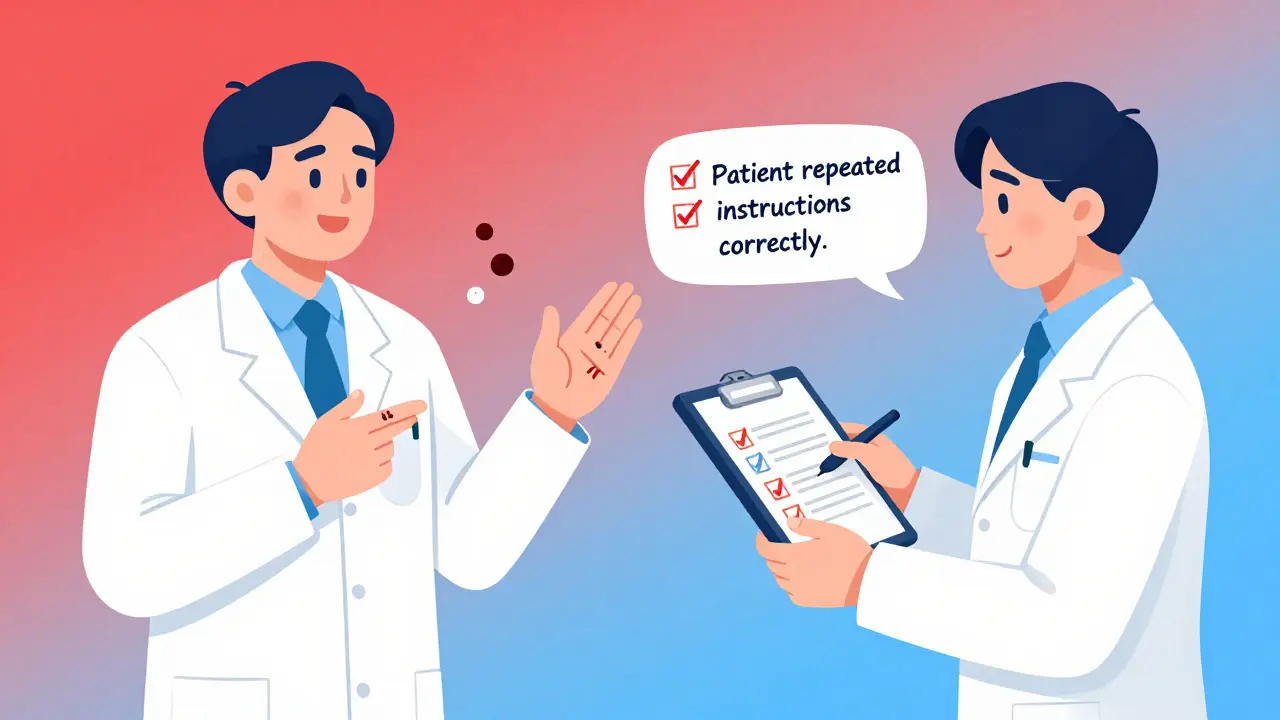
Most pharmacies now use electronic systems with checkboxes. “Did you explain the dose?” - yes/no. “Did patient repeat back instructions?” - yes/no. But here’s the catch: 38 states accept this simple system. California doesn’t. It requires detailed written notes. That’s why pharmacists in California spend 22% more time on documentation than the national average.
And it’s not just paperwork. It’s liability protection. If a patient has a bad reaction and says, “No one told me,” your documentation is your shield.
Technology Is Changing the Game
Walgreens and CVS are testing AI-powered counseling tools. These systems listen to the patient’s answers and adjust the script in real time. If someone says, “I can’t swallow pills,” the system prompts the pharmacist to offer liquid alternatives. If they mention dizziness, it reminds them to check for low blood pressure.
Pilot data from 2023 showed a 23% increase in patient comprehension compared to static scripts. That’s huge. It means fewer mistakes. Fewer calls to the pharmacy. Fewer ER visits.
But here’s the truth: tech doesn’t replace the pharmacist. It helps them do their job better. The best systems still require human judgment. The AI suggests. The pharmacist decides.
What’s Next? The Future of Counseling
By 2025, Medicare Part D will require all plans to verify patient understanding - not just offer counseling. That means pharmacists will need to ask: “Can you tell me how you’ll take this?” - and record the answer.
That’s the future. Not just talking. Not just checking boxes. Making sure the patient walks out knowing what to do.
And it’s working. The $312 billion annual cost of medication non-adherence is finally getting attention. Pharmacists aren’t just filling prescriptions anymore. They’re preventing hospitalizations. Saving lives. And scripts? They’re the tool that makes it all repeatable.
How to Get Started
If you’re a new pharmacist or a student:
- Learn the three-question framework. Master it first.
- Practice with real patients. Don’t memorize. Listen.
- Use the ASHP and CMS guidelines as your base. They’re free and public.
- Don’t fear the script. Use it as a safety net - not a cage.
- Track your own results. Did the patient understand? Did they follow up? That’s your feedback loop.
And if you’re a pharmacy owner? Train your team. Don’t just hand them a PDF. Role-play. Practice. Let them make mistakes in a safe space. Then fix them.
Common Challenges - And How to Fix Them
- Time crunch? Use the three-question model. It’s proven to cut time without cutting quality.
- Language barrier? Use pre-translated handouts (Language Access Network covers 150+ languages). Use telephonic interpreters - they’re free under federal law.
- Script fatigue? Let pharmacists adapt. A rigid corporate script is worse than no script.
- Complex meds? Don’t use a generic script. Use a disease-specific one - for diabetes, anticoagulation, or mental health.
The goal isn’t perfection. It’s consistency. Every patient, every time. Even if it’s just 90 seconds.





Dylan Patrick
March 15, 2026 AT 22:59