

Every year, thousands of patients in hospitals suffer harm because of medication errors. Most of these errors don’t come from careless staff-they come from systems that don’t catch mistakes before they reach the patient. The most dangerous errors involve high-alert medications. These aren’t necessarily the most commonly used drugs, but they’re the ones where even a small mistake can lead to death or permanent injury. That’s why double checks aren’t optional-they’re life-or-death.
What Makes a Medication High-Alert?
A high-alert medication isn’t defined by how often it’s used, but by how much damage it can cause if given wrong. The Institute for Safe Medication Practices (ISMP) first created this category in 2001, and they update their list every two years. The latest version, released in January 2024, lists 19 categories of drugs that demand extra safeguards.These include things like IV insulin, concentrated potassium chloride, heparin infusions, neuromuscular blockers, and chemotherapy drugs. Why these? Because the difference between a safe dose and a lethal one is razor-thin. A single misplaced decimal point in an insulin dose can send a patient into a coma. Giving a muscle relaxant meant for surgery to a conscious patient can stop their breathing. There’s no room for guesswork.
It’s not about the drug being dangerous on its own-it’s about how easily it can be misused. A 100-unit vial of heparin isn’t harmful if used correctly. But if someone grabs it thinking it’s a 10-unit flush, and administers the full dose intravenously? That’s a cardiac arrest waiting to happen.
When Is a Double Check Required?
Not every high-alert medication needs a double check in every situation. The key is matching the safeguard to the risk. The Veterans Health Administration (VHA) and many large hospitals now follow a strict rule: if the consequences of error are catastrophic, the check must be independent and thorough.Here are the medications that almost universally require an independent double check before administration:
- IV insulin infusions and bolus doses
- Potassium chloride concentrate (1 mEq/mL or higher)
- Potassium phosphate concentrate (1 mEq/mL or higher)
- Intravenous heparin (including flushes over 100 units/mL)
- Neuromuscular blocking agents (unless given under full anesthesia control)
- Chemotherapeutic agents (all forms)
- Injectable patient-controlled analgesia (PCA) with opioids
- Total parenteral nutrition (TPN) and lipid infusions
- Direct thrombin inhibitors (like argatroban or bivalirudin)
- Sodium chloride solutions above 0.9% (used for certain IV drips)
Some institutions also require checks for ketamine, CRRT solutions, and all controlled substances-especially if given intravenously. The exact list varies by hospital, but the core principle is the same: if a mistake could kill someone, don’t trust one person to get it right.
What Makes a Double Check Actually Work?
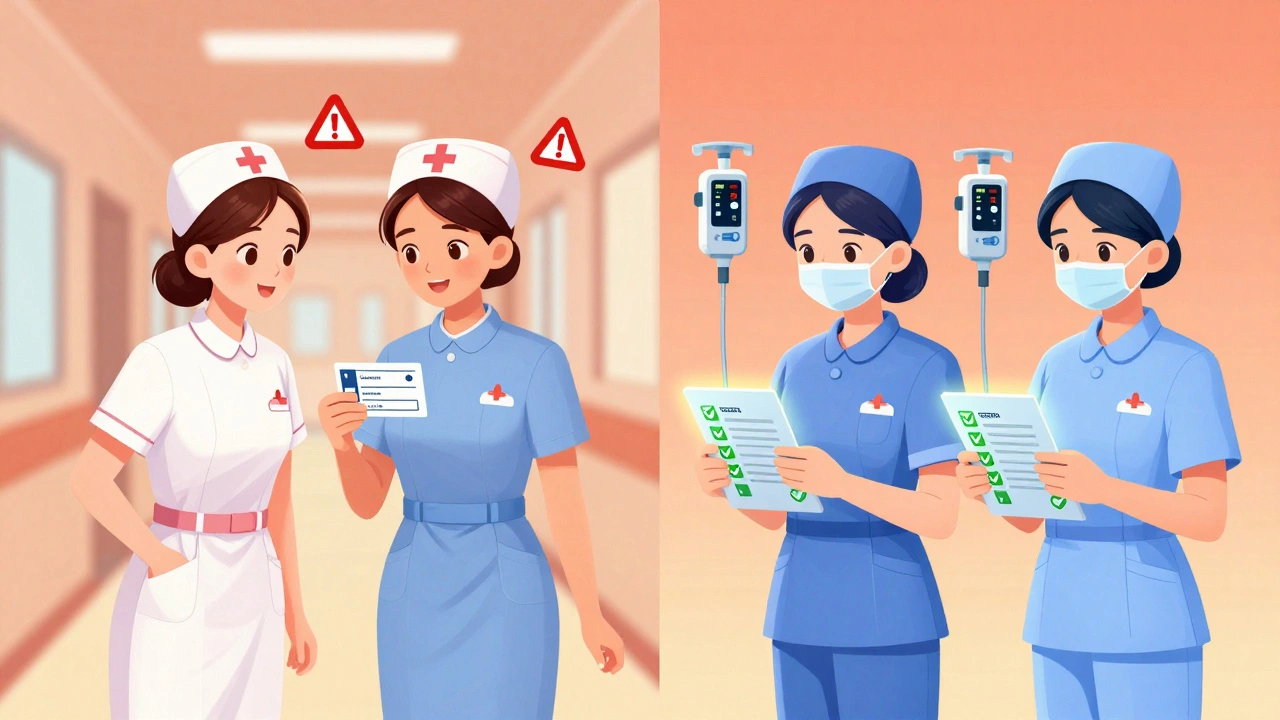
A double check isn’t just two people glancing at the same label. If they stand side-by-side, talk through it, or assume they’re seeing the same thing, you’re not doing a double check-you’re doing a single check with backup.True independent double checks (IDCs) follow three rules:
- They’re done alone. One clinician checks the medication without speaking to the other. No discussing what they think the dose should be. No nodding along.
- They verify five critical elements. Right patient (two identifiers), right medication, right dose, right route, right time. Not just the drug name and number.
- They compare results after each has finished. Only after both have independently completed their check do they sit down and confirm they agree.
At Johns Hopkins Hospital, when they started enforcing this for IV heparin, dosing errors dropped from 12.7% to just 2.3% in 18 months. That’s not luck. That’s process.
But here’s the catch: if you rush it, it’s useless. A 2017 study in the Journal of Patient Safety found that when nurses performed "simultaneous checks"-meaning they checked together and talked through it-the error detection rate fell to 32%. That’s worse than having no check at all.
Why So Many Double Checks Fail
You’d think hospitals would have this nailed. But they don’t. Why?First, time. Nurses are stretched thin. Adding two minutes to every high-alert med administration sounds small-but when you’re managing five patients, one of whom is crashing, those two minutes feel impossible. In emergency departments, 82% of nurses say there’s rarely a second nurse available during a code.
Second, unclear rules. In one ISMP study, 38% of double check failures happened because staff didn’t know exactly what to check. Was it just the dose? Or the pump rate too? The route? The patient’s renal function? If the protocol doesn’t spell it out, people guess-and guesses kill.
Third, culture. Too often, double checks become a box-ticking exercise. One nurse says, "I checked it," the other says, "Okay, I checked it too," and they sign off. No real verification. A nurse on Reddit’s r/Nursing shared: "I’ve caught three errors in six months doing real IDCs. But I’ve seen 12 where it was just a quick nod and a signature. One of those missed a 10x overdose. The patient survived by luck."
And then there’s documentation. Electronic MAR systems now require two digital signatures. But if the system doesn’t force you to enter each step-like pump settings or calculated dose-it becomes another formality.
How to Build a Real Double Check System
Fixing this isn’t about adding more rules. It’s about smarter design.Start with these four steps:
- Identify your highest-risk meds. Don’t apply double checks to everything. Look at your own error data. Which drugs caused the most harm? Focus there.
- Write crystal-clear protocols. What exactly must be checked? For insulin: verify concentration, dose, syringe size, pump settings, and patient’s blood glucose trend. Don’t say "check the dose." Say "calculate the dose from the order, then verify the syringe label matches the calculated amount."
- Train properly. One-hour PowerPoint slides won’t cut it. Cleveland Clinic requires a two-hour competency module with simulations. Nurses must pass a real-life scenario test before they’re allowed to perform IDCs. Pass rate? 95%.
- Use technology to support, not replace, humans. Smart pumps that block incorrect doses? Essential. EHR systems that auto-calculate insulin doses and flag mismatches? Vital. But don’t let the machine do the thinking. Use it to catch the obvious. The human still checks the context: Is this patient septic? Are they on dialysis? Does this dose make sense?
At Mayo Clinic, they built double-check time into staffing models. If you’re giving IV insulin, you’re not expected to do it alone. Someone else is scheduled to be available. That’s how you make safety sustainable.
What’s Changing in 2025?
The future of medication safety isn’t more paperwork. It’s smarter tools.The Joint Commission now requires all accredited hospitals to have formal safeguards for high-alert meds. CMS ties reimbursement to safety performance. That means hospitals can’t ignore this anymore.
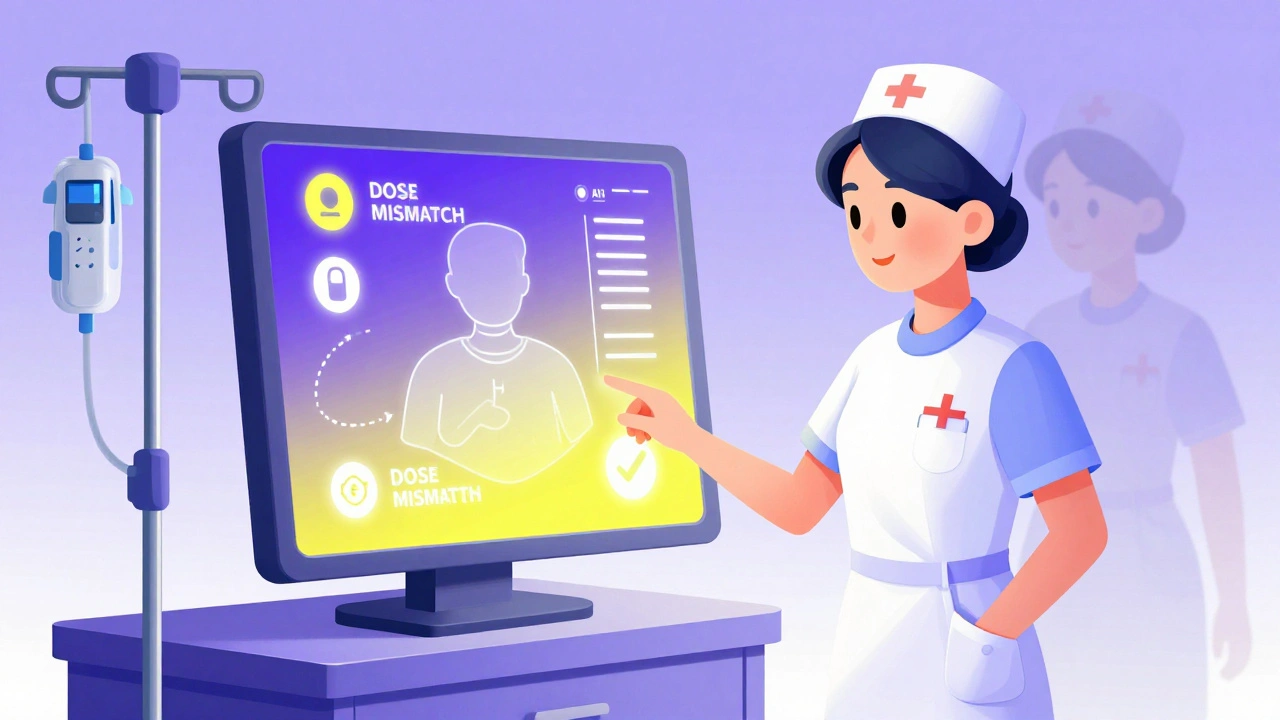
More than 65% of large hospitals now use smart pumps that connect to eMAR systems. If a nurse tries to program a 100-unit/hour heparin drip, the pump flags it. If the dose doesn’t match the order, it won’t start. That’s a forcing function-technology that prevents the error before it happens.
Some academic centers are piloting AI tools that analyze patient data and suggest if a dose is unsafe. For example, if a patient has kidney failure and you’re about to give a drug cleared by the kidneys, the system auto-flags it and prompts a second review.
But here’s the truth: no algorithm will replace a trained human who knows the patient’s history, who notices the trembling hand, who asks, "Why is this dose ten times higher than last week?"
That’s why the most effective systems combine technology with disciplined human checks-for the highest-risk cases only.
Final Thought: Safety Isn’t About Rules. It’s About Respect.
High-alert medications aren’t the enemy. The enemy is complacency. The belief that "it won’t happen here." The rush to get through the list. The assumption that someone else checked it.Real safety means slowing down when it matters. It means trusting your gut when something feels off. It means having the courage to say, "I need a second pair of eyes," even if it delays the next task.
The next time you prepare an IV insulin dose, don’t just check the label. Calculate it yourself. Compare it to the order. Verify the pump setting. Ask yourself: if this were my mother, would I be comfortable giving this without a second check?
If the answer isn’t a firm yes-then you already know what to do.
What are the most common high-alert medications that require double checks?
The most common high-alert medications requiring independent double checks include IV insulin, concentrated potassium chloride (1 mEq/mL or higher), intravenous heparin (over 100 units/mL), neuromuscular blocking agents, chemotherapy drugs, and injectable patient-controlled analgesia (PCA) with opioids. These are listed in the 2024 ISMP High-Alert Medications List and are used in nearly all acute care settings.
Is a double check always necessary for every high-alert medication?
No. The Institute for Safe Medication Practices (ISMP) advises against blanket double-check requirements. Instead, they recommend using independent double checks only for the highest-risk medications and situations-like IV insulin in unstable patients or chemotherapy doses. For other high-alert drugs, automated systems like smart pumps or dose error reduction software may be more effective and less disruptive to workflow.
What’s the difference between a simultaneous check and an independent double check?
A simultaneous check happens when two people verify the medication together, often talking through it or looking at the same label. An independent double check means each person verifies the medication alone, without influence from the other. They only compare results after both have completed their own check. Independent checks catch 95% of errors when done correctly; simultaneous checks drop effectiveness to as low as 40%.
What happens if there’s no second nurse available during an emergency?
In emergencies, many hospitals allow a single qualified clinician to administer high-alert medications when a second person isn’t immediately available. But this must be documented and followed by a retrospective double check as soon as possible. Some institutions use a "safety pause"-a brief moment to verify the drug, dose, and patient before giving it, even alone. Technology like smart pumps with built-in alerts is critical in these situations to reduce risk.
How do hospitals track compliance with double-check protocols?
Hospitals use electronic medication administration records (eMAR) that require two digital signatures for high-alert medications. They also conduct regular chart audits, where staff review a sample of administrations to confirm that all required steps were followed. Some hospitals use direct observation during rounds or random spot checks. Compliance rates are often tied to departmental performance reviews and patient safety metrics.




Eddy Kimani
December 3, 2025 AT 04:42