
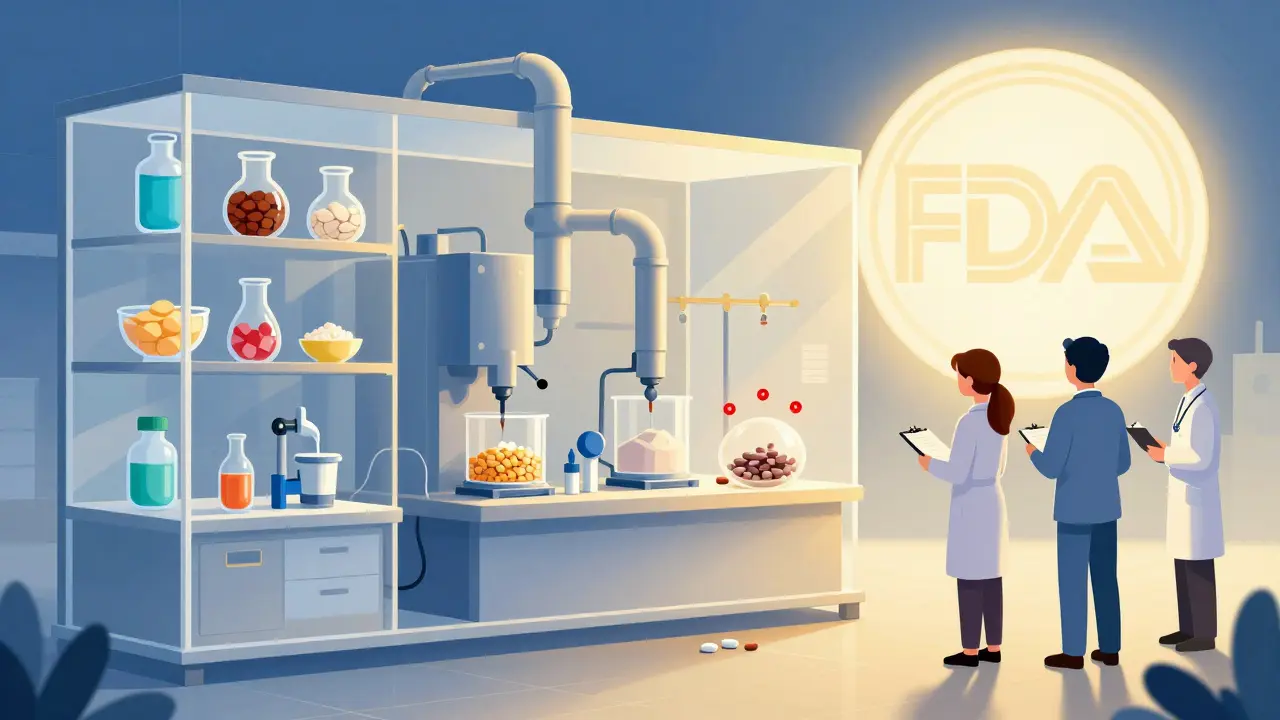
The U.S. Food and Drug Administration doesn’t just approve generic drugs - it makes sure they’re just as safe and effective as the brand-name versions. And it doesn’t rely on luck or final product tests. Instead, the FDA builds quality into every step of the manufacturing process, from the first raw ingredient to the last pill in the bottle.
Why Quality Starts Before the Pill is Made
In the 1960s, the FDA tested nearly 5,000 drugs and found that 8% of them didn’t deliver the right amount of medicine. Some had too much - risking overdose. Others had too little - leaving patients untreated. That discovery changed everything. Instead of checking pills after they were made, the FDA started asking: How is this drug made? The answer became Current Good Manufacturing Practices, or cGMP. These aren’t suggestions. They’re federal law under Title 21 of the Code of Federal Regulations.Generic drug makers must follow the same rules as brand-name companies. There’s no lower standard just because the price is lower. The FDA’s Office of Generic Drugs (OGD) works hand-in-hand with the Office of Pharmaceutical Quality (OPQ) to make sure every step of production meets those standards. That means if a company wants to sell a generic version of a heart medication, they have to prove they can make it exactly like the original - down to the particle size, the binding agent, and how fast it dissolves in the body.
The Five Pillars of FDA’s Quality System
The FDA doesn’t guess. It checks. And it checks five key areas, every time.- Control of Materials: Every raw ingredient must be traced back to its source. If a batch of active pharmaceutical ingredient (API) comes from India, the FDA wants to know the supplier’s name, the lot number, and how it was stored. Contaminants? No. Substandard material? Rejected.
- Production and Process Controls: Every step - mixing, granulating, compressing, coating - has a written procedure. Machines are calibrated. Temperatures are logged. If a mixer runs 5 degrees too hot, the batch is held. The team must explain why and fix it before moving on.
- Quality Control and Laboratory Testing: Samples are tested at every stage. Raw materials. In-process blends. Final tablets. Tests aren’t just done - they’re validated. And every result must be ALCOA+: attributable, legible, contemporaneous, original, accurate, complete, consistent, enduring, and available. No scribbles. No backdated logs. No deleted files.
- Packaging and Labeling: A mislabeled pill can kill. The FDA checks that the label matches the drug, the strength, the expiration date, and the lot number. Barcodes are scanned. Foreign language labels are verified. Blister packs are tested for moisture resistance.
- Documentation and Record Keeping: Everything is written down. No exceptions. If it wasn’t recorded, it didn’t happen. These records can be pulled at any time - during an inspection or after a complaint. They’re the paper trail that proves the drug was made right.
Unannounced Inspections - The Real Enforcer
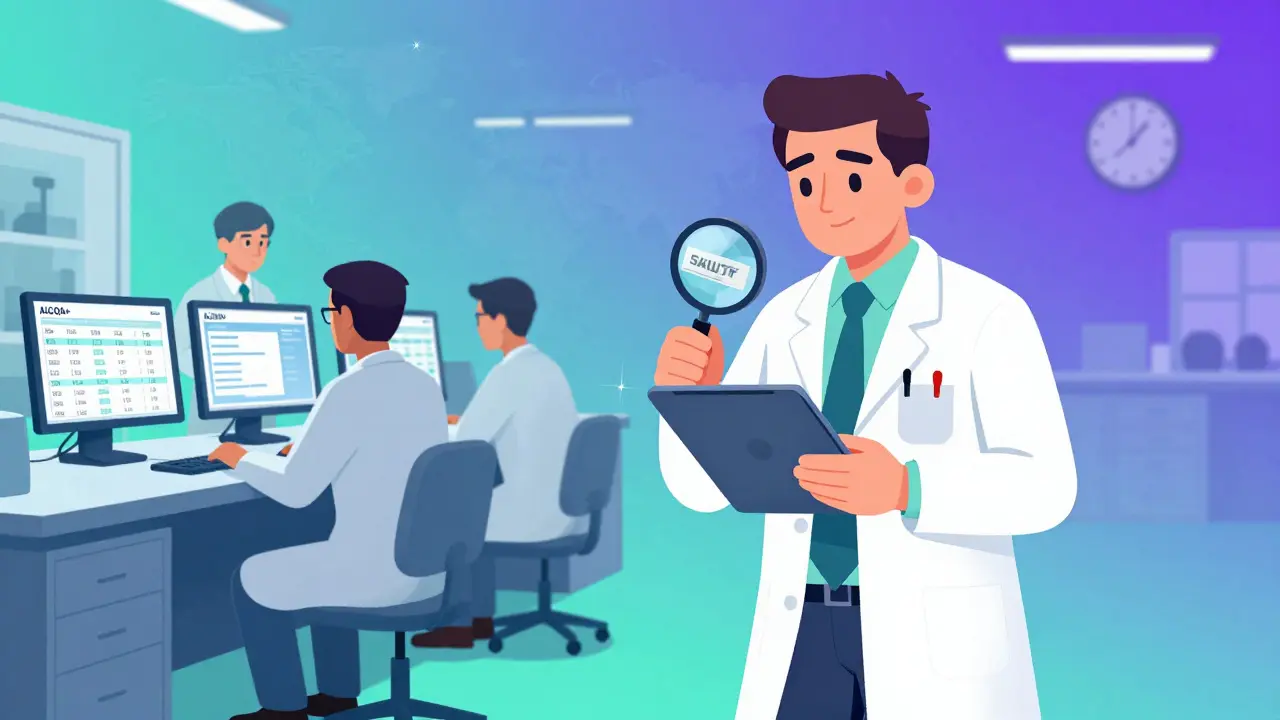
You can’t fake quality. The FDA knows that. That’s why inspectors show up without warning. They don’t call ahead. They don’t give you time to clean up. They walk into factories in the U.S., India, China, and beyond - sometimes staying for days - to watch the process in real time.The Office of Manufacturing Quality (OMQ) conducts about 1,200 inspections each year across 1,700 global facilities that supply the U.S. market. In 2022, 17% of foreign sites had cGMP violations. Domestic sites? 8%. That gap isn’t because U.S. plants are better - it’s because foreign facilities often lack the resources or training to keep up. The FDA doesn’t ignore that. It flags it. And if problems aren’t fixed, the drug gets blocked from entering the country.
Even remote inspections are now common. After the pandemic, the FDA started using video calls and digital document reviews to check records and observe processes. About 35% of 2022 inspections included some remote component. But the goal stays the same: see it, verify it, trust it.
Three Batches, One Rule
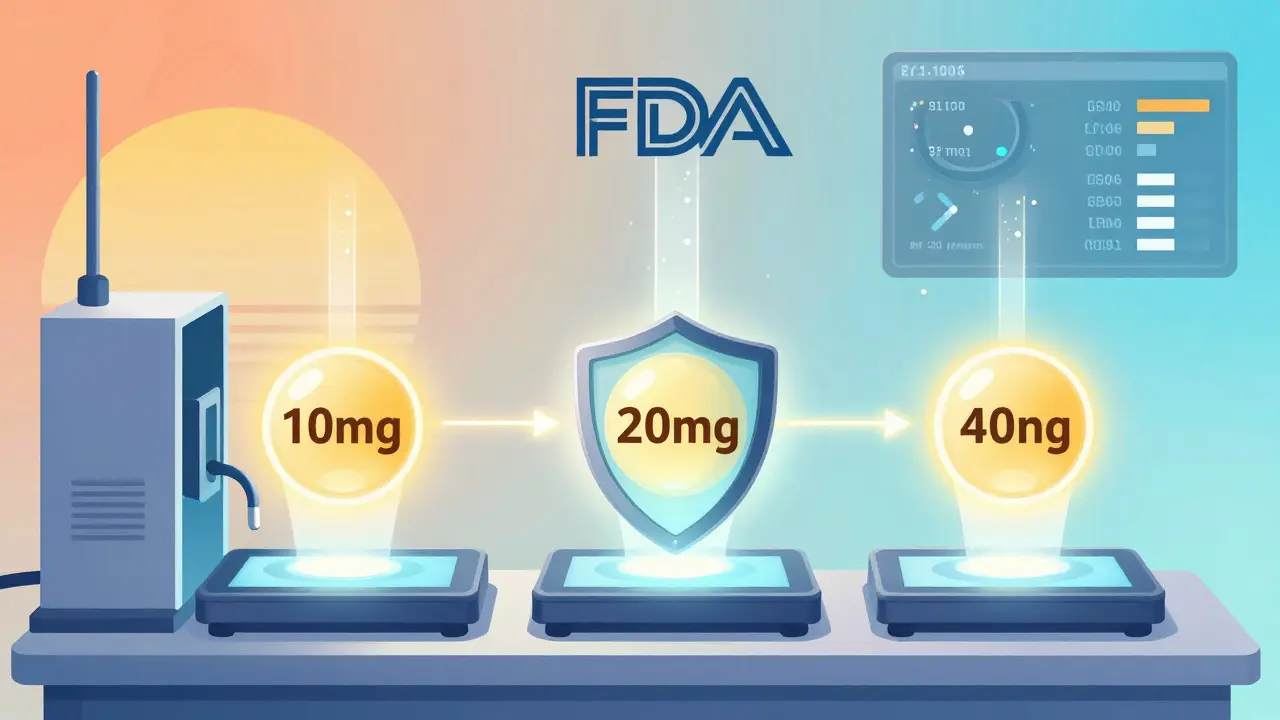
Here’s something most people don’t know: when a company submits a generic drug application, they don’t just send one batch. They send three. One batch is used to make the lowest strength. Another for the highest. And the third? That’s the one used for all the middle strengths. Why? Because if the process works for the strongest pill, it should work for the weakest. If it fails on one, it fails on all.This isn’t about wasting product. It’s about proving consistency. The FDA wants to see that the same machine, the same operator, the same recipe - can produce 10 mg, 20 mg, and 40 mg tablets with the same precision. No guessing. No shortcuts.
How the FDA Catches Problems Before They Happen
The FDA doesn’t wait for patients to get sick before acting. It uses data to predict risk. Since 2023, the Drug Quality Reporting System (DQRS) lets manufacturers report quality issues faster - like a malfunctioning machine or a batch that didn’t meet specs. That data feeds into a risk model that flags high-risk companies and products before they hit the market.They also do random product sampling. If a generic blood pressure pill is pulled from a pharmacy shelf and tested, and it’s 15% weaker than it should be, the FDA doesn’t just recall it. They trace it back to the factory. They shut down the line. They demand a root cause analysis. And they publish the findings.
During the pandemic, this system kept critical drugs like antibiotics and ICU medications available. When a factory in Italy had a supply chain issue, the FDA didn’t panic. They used their risk model to shift production to another facility that was already qualified - without compromising quality.
Costs, Challenges, and the Real Price of Quality
Building a facility that meets FDA standards isn’t cheap. New manufacturers spend $2 million to $5 million just on quality systems before they even submit their first application. Training staff alone takes 18 to 24 months. Documentation eats up 30-40% of development time for smaller companies.But the payoff is huge. Generic drugs make up 90% of all prescriptions filled in the U.S. - 6.8 billion pills a year. And they cost 80-85% less than brand-name versions. That’s billions saved for patients, insurers, and taxpayers. The FDA’s system isn’t perfect - inspections are still limited by staffing, and some companies cut corners. But the data shows it works: 98-99% of generic drugs are therapeutically equivalent to their brand-name counterparts.
Industry surveys show 68% of manufacturers think FDA rules are stricter than Europe’s or Japan’s. But 82% also say those rules make their products better. That’s not coincidence. It’s design.
What’s Next for Generic Drug Quality?
The FDA isn’t resting. The Pharmaceutical Quality for the 21st Century initiative is pushing for smarter manufacturing. Think real-time testing - where sensors on the production line measure drug strength as it’s made, not hours later in a lab. Think continuous manufacturing - where pills are made in one unbroken flow instead of in batches. These aren’t sci-fi ideas. Draft guidance is already out, and companies are testing them.By 2025, new rules may require manufacturers to fully document where their active ingredients come from - down to the farm or chemical plant. That’s a big shift. But it’s also a necessary one. Global supply chains are fragile. Transparency isn’t optional anymore.
The Generic Drug User Fee Amendments (GDUFA) III, which started in 2022, gave the FDA $650 million over five years to hire more inspectors, upgrade labs, and improve data systems. That’s money spent on keeping you safe - not just on paperwork.
At the end of the day, the FDA’s job isn’t to make drugmakers rich. It’s to make sure that when you pick up a $4 generic pill, you’re getting the same medicine your doctor prescribed - no matter where it was made. And that’s not just regulation. It’s a promise.





Layla Anna
December 31, 2025 AT 22:20