
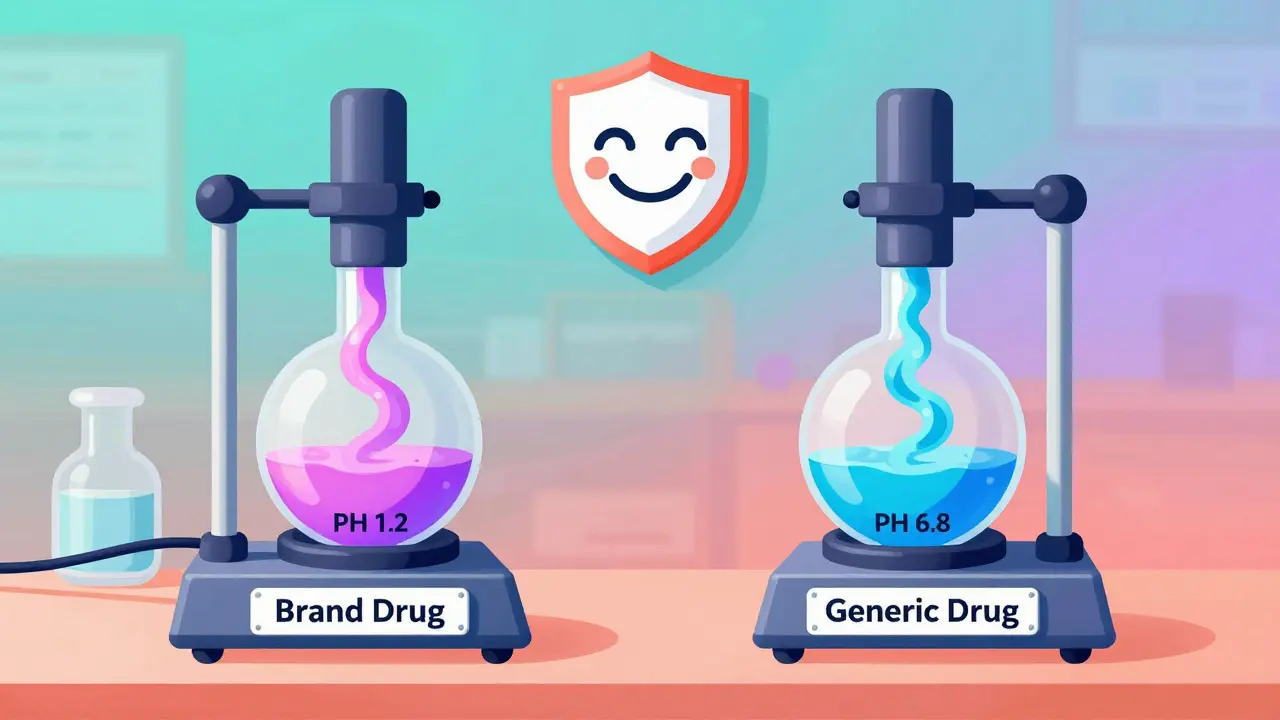
Imagine developing a generic version of a popular pill-say, a common blood pressure medication-and instead of recruiting 24 healthy volunteers, running blood tests for days, and spending half a million dollars, you could skip all of it. Just run a simple lab test with dissolution machines, compare the results, and get FDA approval. That’s not science fiction. That’s a bioequivalence waiver-and it’s a real, regulated shortcut used every day in the generic drug industry.
What Exactly Is a Bioequivalence Waiver?
A bioequivalence waiver, or biowaiver, is when the FDA says: "You don’t need to test this drug in people." Normally, to prove a generic drug works the same as the brand-name version, companies must run in vivo studies-giving the drug to volunteers, measuring drug levels in their blood over time, and comparing the results. It’s expensive, slow, and ethically tricky if you’re just testing a pill that’s chemically identical. But if the drug meets strict scientific criteria, the FDA lets you skip the human part. Instead, you prove equivalence using in vitro (lab-based) dissolution tests. These tests mimic how the pill breaks down in the stomach and intestines by dissolving it in fluids at different pH levels (1.2, 4.5, and 6.8). If the generic dissolves at the same rate and extent as the brand, and the drug’s properties are predictable, the FDA accepts that as proof.Which Drugs Qualify for a Waiver?
Not every pill qualifies. The FDA only allows biowaivers for immediate-release solid oral dosage forms-think tablets or capsules you swallow, not liquids, patches, or extended-release versions. And even then, only if the active ingredient fits into one of two categories under the Biopharmaceutics Classification System (BCS).- BCS Class I: High solubility, high permeability. These are the easiest to waive. Examples include metoprolol, atenolol, and ciprofloxacin. The drug dissolves quickly in the gut and gets absorbed efficiently. For these, you need to show that your generic dissolves at least 85% within 30 minutes across all pH levels, and that the dissolution profiles match the brand within an f2 similarity factor of 50 or higher.
- BCS Class III: High solubility, low permeability. These are trickier. The drug dissolves well but doesn’t cross cell membranes easily. The FDA requires more proof here: identical excipients (fillers, binders), no absorption differences based on where in the gut it dissolves, and matching dissolution profiles. Examples include acyclovir and aliskiren.
BCS Class II (low solubility, high permeability) and Class IV (low solubility, low permeability) drugs? No waivers. Their absorption is too unpredictable. You still need human trials.
Why Does This Matter?
The savings are massive. A single in vivo bioequivalence study costs between $250,000 and $500,000 and takes 6 to 12 months. A dissolution test? $5,000 to $15,000, done in weeks. For generic manufacturers, this isn’t just convenience-it’s survival. In 2022, about 18% of all Abbreviated New Drug Applications (ANDAs) for solid oral products included biowaiver requests. That’s up from 12% in 2018. Companies like Teva and Mylan use biowaivers in 25-30% of their development pipelines. Smaller firms use them less, not because they don’t want to, but because setting up the right dissolution methods takes expertise and time. One formulation scientist reported saving $4.2 million and cutting approval times by 8-10 months per product over three years-just by using biowaivers. That’s billions saved industry-wide, and faster access to affordable drugs for patients.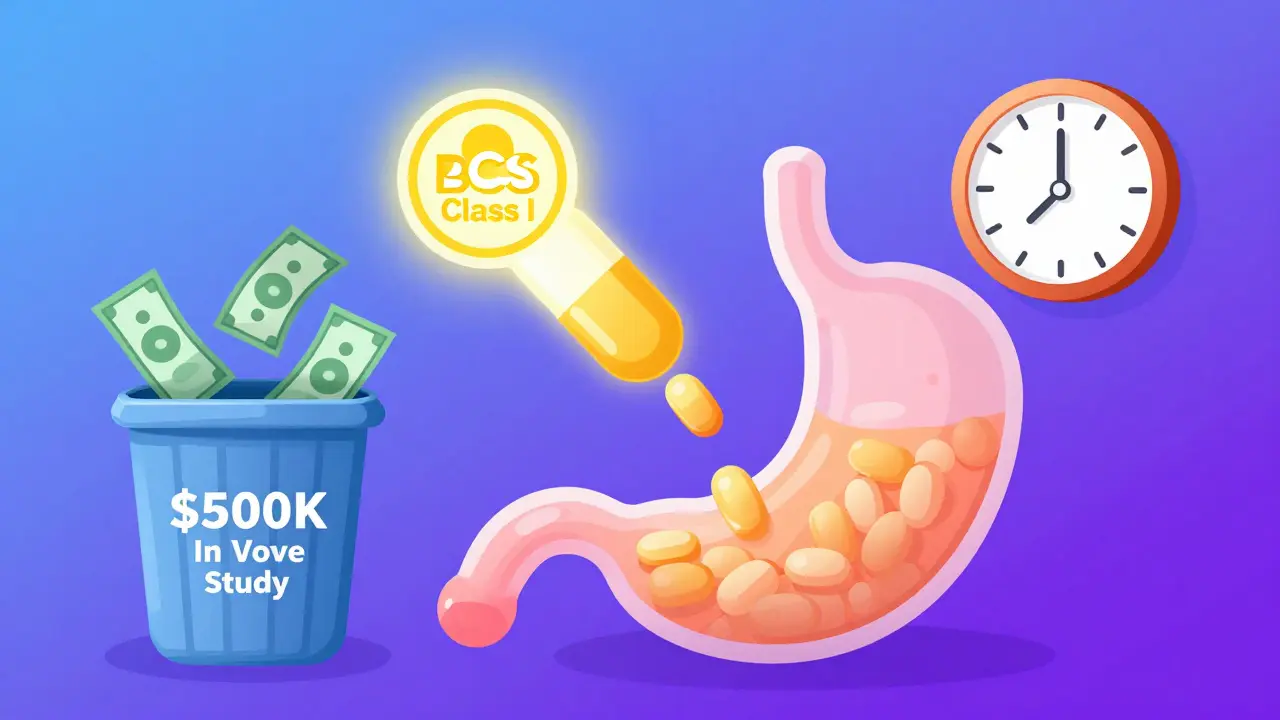
How Do You Actually Get a Waiver Approved?
It’s not as simple as saying, "My pill dissolves fast." The FDA demands precision.- You must test at least 12 units of your product and the reference product.
- Dissolution testing must include sampling at 10, 15, 20, 30, 45, and 60 minutes.
- The dissolution method must be discriminatory-meaning it can tell the difference between a good and bad formulation. If your test can’t detect a 10% change in dissolution, it’s rejected.
- You must prove the drug is BCS Class I or III using published data or new solubility/permeability studies.
- For Class III, you need to show excipients are identical and absorption isn’t affected by gut location.
Over 35% of rejected applications fail because the dissolution method isn’t discriminatory enough. That’s why many companies hire consultants with 5+ years of formulation experience. Even then, approval isn’t guaranteed.
There’s a better way: use the FDA’s Pre-ANDA program. Companies that meet with FDA reviewers before submitting get a 22% higher approval rate for biowaivers. It’s not mandatory, but it’s smart.
What’s Changing? The Future of Biowaivers
The FDA isn’t standing still. In 2022, they released draft guidance to expand biowaivers to more BCS Class III drugs. In 2023, they started a pilot program to evaluate waivers for certain narrow therapeutic index drugs-like warfarin and levothyroxine-where even small differences can be dangerous. Their 2023-2027 strategic plan aims to increase biowaiver opportunities by 25% by improving in vitro-in vivo correlation models. That means future waivers might cover more complex formulations, maybe even some extended-release products. But challenges remain. A 2023 FDA committee report found that 85% of complex generics-like patches, inhalers, or modified-release tablets-still can’t use biowaivers. The science isn’t there yet.
Why Isn’t Everyone Using Biowaivers?
Some companies don’t use them because they don’t know how. Others try and get rejected. One regulatory affairs specialist posted on a pharma forum that three out of five Class III biowaiver requests were denied-even though they met all the technical criteria. Why? Inconsistent interpretation across FDA review divisions. A 2022 PhRMA survey found that 42% of companies reported inconsistent standards. One reviewer might accept a dissolution profile with an f2 of 52; another might demand 58. It’s not written in stone. That’s why pre-submission meetings matter so much.Is This Safe?
Yes. The BCS-based biowaiver system has been validated over decades. Studies show over 95% concordance between in vitro predictions and actual in vivo results for BCS Class I drugs. The FDA doesn’t approve waivers based on guesswork. They’re grounded in pharmacokinetic science, decades of clinical data, and rigorous testing protocols. It’s not about cutting corners. It’s about using the right tool for the right job. If dissolution is the only thing that limits absorption-and science proves it-why test people?What’s Next for Generic Drug Developers?
If you’re developing a generic drug, ask yourself: Is the active ingredient BCS Class I or III? Can you build a discriminatory dissolution method? Do you have the right expertise-or access to it? Start early. Run solubility and permeability tests before you even make a batch. Talk to the FDA during the Pre-ANDA stage. Don’t wait until you’ve spent $100,000 on a failed study. The future of generic drug development isn’t about doing more human trials. It’s about doing smarter ones-or skipping them altogether when science allows.Can any generic drug get a bioequivalence waiver?
No. Only immediate-release solid oral dosage forms that meet BCS Class I or III criteria qualify. Extended-release, liquid, injectable, or topical products are excluded. Narrow therapeutic index drugs are generally not eligible, except under specific FDA pilot programs.
How much money can a company save with a biowaiver?
Companies save between $250,000 and $500,000 per product by avoiding in vivo studies. Additional savings come from faster approval timelines-typically 8 to 10 months earlier-which means earlier market access and revenue.
What is the f2 similarity factor?
The f2 factor is a statistical measure used to compare dissolution profiles between two products. An f2 value of 50 or higher indicates similarity. It’s calculated using dissolution data points at multiple time intervals and considers the mean percentage dissolved for both the test and reference products.
Why are BCS Class II drugs excluded from biowaivers?
BCS Class II drugs have low solubility, meaning their absorption depends heavily on how well they dissolve in the gut. Small changes in formulation-like a different binder or coating-can drastically affect dissolution and absorption. Since in vitro tests can’t reliably predict in vivo performance for these drugs, human studies are still required.
Do other countries accept FDA biowaivers?
Yes. The International Council for Harmonisation (ICH) adopted M9 guidelines in 2021, which standardize BCS-based biowaivers across the U.S., EU, Japan, Canada, and other member countries. Many regulatory agencies now accept FDA-approved biowaivers, especially for Class I drugs, reducing the need for duplicate testing globally.




Doreen Pachificus
January 5, 2026 AT 06:26