
For decades, bioequivalence testing has been the gatekeeper for generic drugs. If a generic version of a drug doesn’t behave the same way in the body as the brand-name version, it doesn’t get approved. But the old methods-giving pills to healthy volunteers, drawing blood every hour for days, and waiting weeks for results-are slowing down. In 2026, that’s changing. New technologies are cutting study times in half, slashing costs, and even eliminating some human trials entirely. This isn’t science fiction. It’s happening right now in FDA labs and CROs around the world.
AI Is Rewriting the Rules of Bioequivalence
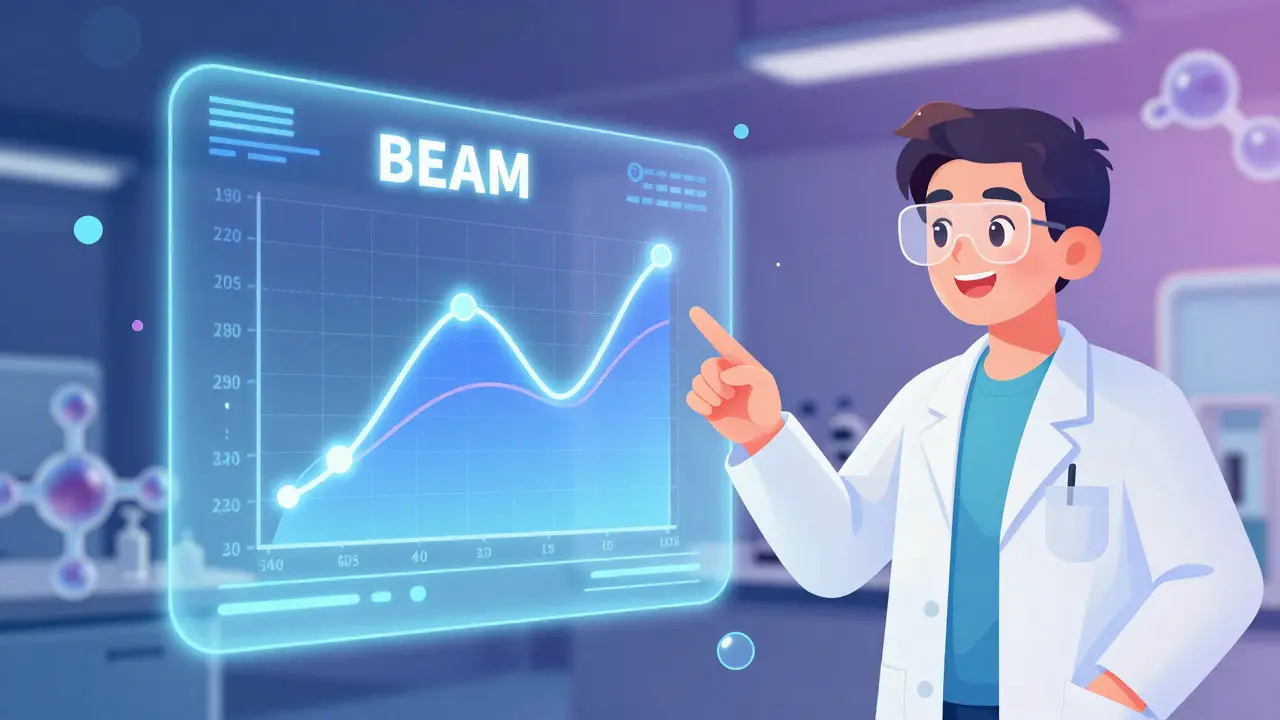
The biggest shift isn’t in the lab-it’s in the data room. The FDA launched BEAM (Bioequivalence Assessment Mate) in mid-2024, an AI-powered tool that automates the analysis of pharmacokinetic data. Before BEAM, reviewers spent over 50 hours per application just cleaning up data, checking for outliers, and running statistical models. Now, that’s down to under 20 hours. BEAM doesn’t just speed things up-it finds patterns humans miss. It flags subtle differences in absorption curves that could mean a generic isn’t truly equivalent, even if it passes the old 80-125% AUC and Cmax thresholds.
Machine learning models are also being trained on decades of historical bioequivalence studies. These models now predict how a new formulation will behave based on its chemical structure, excipients, and dissolution profile. This means companies can tweak a tablet formula on a computer before ever making a single pill. One manufacturer reported cutting development time for a complex extended-release capsule from 18 months to 7 months by using these AI models to simulate PK profiles.
Imaging Tech Sees What Blood Tests Can’t
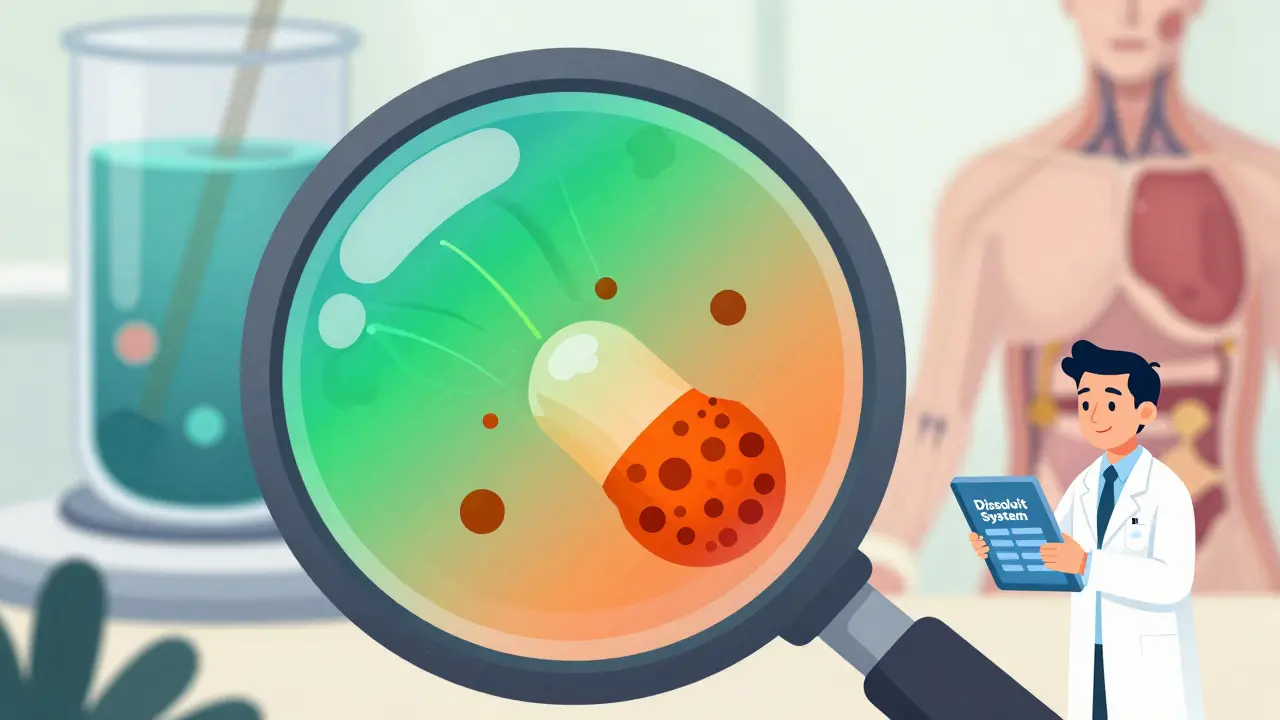
Traditional bioequivalence studies measure drug concentration in the blood. But what if the drug never even leaves the pill? That’s where advanced imaging comes in. The FDA now uses scanning electron microscopy (SEM) and atomic force microscopy infrared spectroscopy to examine how drug particles dissolve at the microscopic level. For drugs with poor solubility, like many cancer meds or antifungals, this matters. Two pills might have identical chemical composition, but if one releases its active ingredient in clumps and the other dissolves evenly, their bioavailability can differ by 30%-something a blood test might never catch.
Another breakthrough is optical coherence tomography, which creates real-time 3D images of how a pill breaks down in simulated gut fluid. This isn’t just for research. The FDA’s Dissolvit system, a proprietary dissolution apparatus with real-time imaging, is now being used to test inhaled and topical products. For transdermal patches, where adhesion and skin penetration vary wildly between batches, this imaging lets regulators see exactly how the drug moves through the layers of skin-not just how much ends up in the bloodstream.
VIRTUAL BE: The End of Human Trials for Many Drugs?
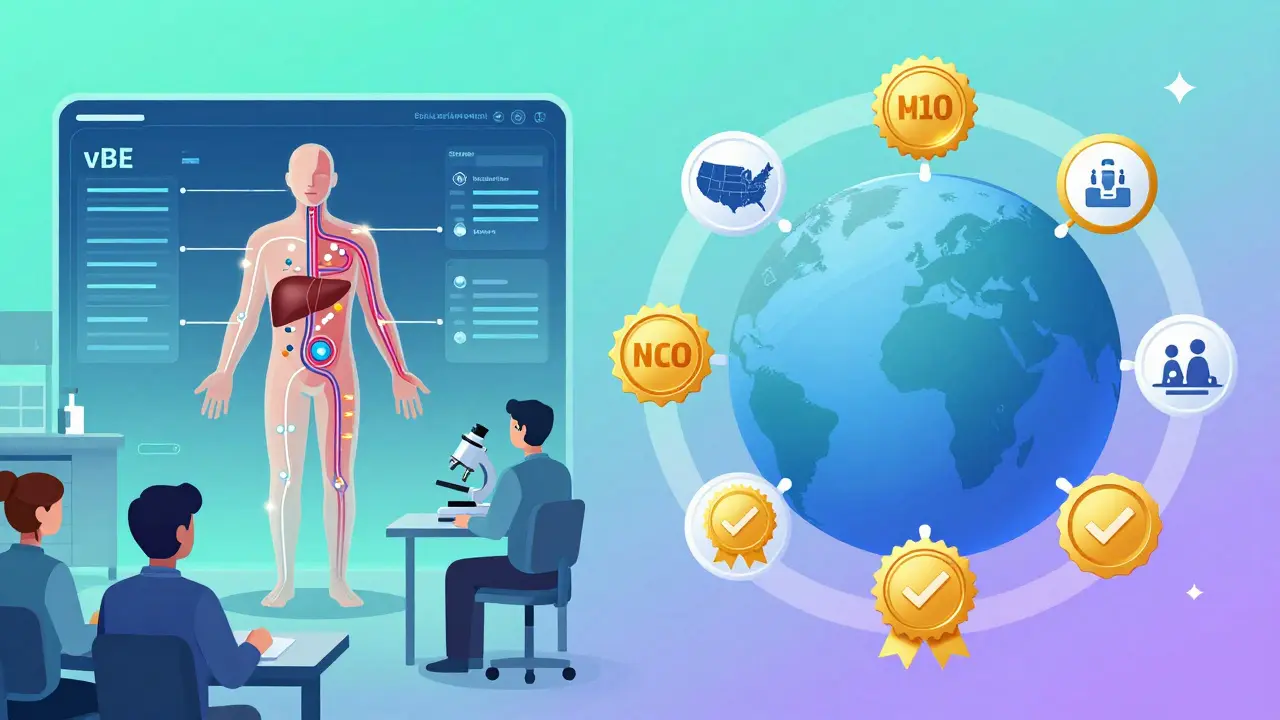
One of the most controversial advances is the virtual bioequivalence (vBE) platform. Funded by the FDA in August 2024, this system uses computer simulations to predict how a drug behaves in the human body. It combines data from dissolution tests, tissue absorption models, and metabolic enzyme activity to generate a virtual PK profile. The FDA’s pilot program showed vBE could replace clinical trials for 65% of complex generics-especially those with modified release, nanoparticles, or biologics.
For example, a generic version of a long-acting insulin analog used to require a 72-hour clinical study with 24 volunteers. Now, with vBE, the same assessment can be done in 48 hours using lab data and simulations. The FDA approved its first vBE-based generic in December 2025. It’s not magic. The model was validated against 87 real-world studies. But it’s real. And it’s saving millions per product.
Harmonization: ICH M10 Unifies Global Standards
Before 2024, getting a generic approved in the U.S. and Europe meant doing two sets of bioanalytical validation. The FDA had one set of rules. The EMA had another. Labs spent months revalidating methods just to switch regions. That changed when the ICH M10 guideline was adopted in June 2024. This single framework now covers sample collection, calibration, accuracy, precision, and stability testing for all bioequivalence studies.
The impact? A 62% drop in method validation errors between regions. Labs no longer need separate teams for U.S. and EU submissions. One CRO in Singapore reported a 40% reduction in operational costs after switching to ICH M10-compliant workflows. This harmonization is especially critical as biosimilars surge-76 have been approved by the FDA as of October 2025-and more companies are launching global generic portfolios.
Where the Tech Still Falls Short
Not every drug is ready for AI or imaging. For simple, immediate-release small-molecule generics-like ibuprofen or metformin-traditional PK studies are still cheaper and more reliable. A standard bioequivalence study costs $1-2 million. A technology-enhanced one? $2.5-4 million. For low-cost generics, that’s not worth it.
Some delivery systems are still too complex. Transdermal patches? The challenge isn’t absorption-it’s skin irritation and patch adhesion. No imaging system can yet predict whether a patch will peel off after 12 hours in a sweaty patient. Orally inhaled products? The FDA still requires charcoal block studies to block absorption from the GI tract, which can’t be simulated. Topical creams? The composition of the base matters as much as the drug. Two creams with identical active ingredients can behave completely differently if one has more ceramides or a different emulsifier.
And then there’s the regulatory catch. In October 2025, the FDA launched a pilot program requiring all bioequivalence testing for certain ANDAs to be done in the U.S. using only domestically sourced APIs. That means even if a company has a perfect AI model, if its API comes from India or China, it can’t use the new tech for accelerated review. This policy is meant to boost U.S. manufacturing-but it creates a two-tier system.
What’s Next? The Road to 2030
By 2030, the FDA expects 75% of standard generic applications to be reviewed using AI-driven tools. The next frontier? In vitro-in vivo correlation (IVIVC) models for advanced injectables, ophthalmic drops, and oligonucleotide therapies. The agency is funding projects to build mechanistic IVIVC for PLGA implants-tiny biodegradable rods that release drugs over months. These were nearly impossible to test before. Now, labs are using AI to match dissolution profiles with tissue uptake patterns.
The market is responding. Bioequivalence testing services are projected to grow from $4.54 billion in 2025 to $18.66 billion by 2035. The biggest drivers? Biosimilars, AI, and regulatory pressure. The FDA’s GDUFA II goal-to review 90% of generic applications within 10 months by 2027-is forcing everyone to innovate. Companies that cling to 2010-era methods will get left behind.
But the biggest risk? Overconfidence. Dr. Michael Cohen of ISMP warned that relying solely on in vitro models for narrow therapeutic index drugs-like warfarin or thyroid meds-could be dangerous. A model might say two formulations are equivalent. But if the real patient’s liver metabolizes the drug differently? That’s where clinical correlation still matters. The future isn’t AI or humans. It’s AI and humans-working together.
What is bioequivalence testing and why does it matter?
Bioequivalence testing compares how quickly and completely a generic drug is absorbed into the bloodstream compared to the brand-name version. If the generic doesn’t deliver the same amount of active ingredient at the same rate, it won’t work the same way in patients. This isn’t just about cost-it’s about safety and effectiveness. For drugs with a narrow therapeutic window, even small differences can lead to treatment failure or toxicity.
How is AI changing bioequivalence testing?
AI tools like BEAM automate data analysis, reducing review time by over 50%. Machine learning models predict how new drug formulations will behave based on chemical properties, cutting development time. These models also detect subtle PK differences that traditional methods miss, improving accuracy by up to 28%.
Can virtual bioequivalence replace human clinical trials?
For many complex generics-like extended-release tablets, nanoparticles, or biologics-yes. The FDA’s virtual BE platform has already replaced clinical trials in over 65% of eligible cases. But for simple, immediate-release drugs or those with narrow therapeutic indexes, traditional human studies are still required. The key is validation: virtual models must be proven accurate against real-world data before they’re accepted.
What role does the ICH M10 guideline play?
ICH M10, adopted in 2024, unified bioanalytical validation rules between the FDA and EMA. Before this, labs had to validate methods twice. Now, one set of standards applies globally, reducing errors by 62% and cutting costs and delays for international generic manufacturers.
Why can’t all generic drugs use advanced testing methods?
Cost and complexity. Advanced imaging and AI systems cost $2.5-4 million per study, while traditional PK studies cost $1-2 million. For low-cost generics like acetaminophen, the extra expense isn’t justified. Also, some delivery systems-like transdermal patches or inhaled drugs-still lack standardized models to predict performance. Regulatory rules, like the FDA’s U.S.-only API requirement, also limit adoption.



Paul Cuccurullo
March 21, 2026 AT 19:23