

When you’re flying from London to Bangkok, your body doesn’t just adjust to a new time-it has to keep taking pills on schedule. Missing a dose of antimalarials or antiretrovirals by a few hours can mean the difference between staying healthy and ending up in a hospital. And no, setting your phone alarm isn’t enough. Most travelers don’t realize that timing these medications across time zones isn’t just about clocks-it’s about your body’s chemistry, flight schedules, and even what you eat.
Why This Matters More Than You Think
You might think antibiotics are the main concern when traveling abroad, but the real issue lies with antimalarials and HIV medications. Antibiotics rarely need strict timing across time zones. But antimalarials like Malarone and HIV drugs like dolutegravir? They’re different. These drugs have narrow windows where they work. Miss a dose, and the parasite or virus can start multiplying again. In some cases, that leads to drug resistance-something that can’t be undone.Imagine you’re on a 16-hour flight from New York to Tokyo. You take your pill at 8 a.m. New York time. But when you land, it’s 10 p.m. Tokyo time. Do you take the next dose now? Or wait until 8 a.m. Tokyo time? Wrong choice = higher risk of malaria or viral rebound. The CDC reports that 41.7% of travelers miscalculate their first dose timing when entering malaria zones. That’s more than 1 in 3 people.
Antimalarials: It’s Not Just About Taking a Pill
Not all antimalarials are the same. Atovaquone-proguanil (Malarone) is one of the most common. It’s taken daily, but here’s the catch: you need to take it with food-preferably fatty food. A 2008 study showed it absorbs 300-400% better with a meal containing fat. Take it on an empty stomach during jet lag, and you might vomit it up. One Reddit user reported vomiting within 20 minutes after taking Malarone before a flight meal. Result? They had to extend their prophylaxis by four extra weeks.Then there’s artemether-lumefantrine, used for treating malaria. It requires four tablets right away, then four more eight hours later. That’s hard enough in your own time zone. Now imagine doing that on a red-eye flight where meals come at random times. No food? No absorption. No absorption? Treatment fails.
Chloroquine is simpler-it’s taken once a week-but only works in certain regions. Mefloquine is also weekly, which sounds easy. But 12.3% of users report serious side effects like anxiety and hallucinations. So while it’s flexible, it’s not safe for everyone.
Here’s the golden rule: Start your antimalarial before you leave. For Malarone, begin 1-2 days before entering a malaria area. Don’t wait until you land. That’s when most people mess up. Calculate your arrival time in the destination, then count backward. If you land at 3 p.m. local time, take your first dose at 3 p.m. local time, not your home time.
Antiretrovirals: Precision Matters
For people on HIV treatment, timing is even more critical. Unlike antimalarials, which prevent infection, antiretrovirals suppress a live virus. If the drug level drops too low, the virus rebounds. And once it does, it can become resistant.Some drugs are more forgiving than others. Dolutegravir can handle a 12-hour delay. That’s a big win. Raltegravir? Only 8 hours. Protease inhibitors? Just 4-6 hours. If you’re on a protease inhibitor and miss a dose by 8 hours, you’re at risk.
Travelers crossing more than eight time zones should start adjusting their schedule three days before departure. Shift your dose time by one or two hours per day. Going east? Move your dose earlier. Going west? Push it later. Don’t jump 10 hours overnight. Your body needs time to adapt.
A 2022 survey by the International Association of Physicians in AIDS Care found that 23% of HIV-positive travelers missed doses during trips. Of those, nearly 8% saw their viral load spike. One traveler on a flight from London to Sydney missed four doses because his alarms didn’t go off. Six weeks later, his viral load jumped to 1,200 copies/mL. He needed a new drug regimen.

What to Do Before You Fly
Planning ahead isn’t optional. Here’s what to do:- Get your prescription checked at least 4-6 weeks before departure. Ask your doctor: “Is my drug forgiving enough for long flights?”
- Use the CDC’s Malaria Prophylaxis Timing Calculator (launched Feb 2024). It lets you input your flight details and generates a personalized schedule.
- Print out your dosing schedule. Include the local time at each stop. Hand it to your flight attendant if you need help remembering.
- Set alarms on two devices: phone and watch. Label them clearly: “Malarone - Bangkok Time.”
- Carry snacks with fat: nuts, cheese, peanut butter packets. Don’t rely on in-flight meals.
- Bring extra pills. At least a 5-day supply beyond your planned trip length. Delays happen.
Apps That Actually Help
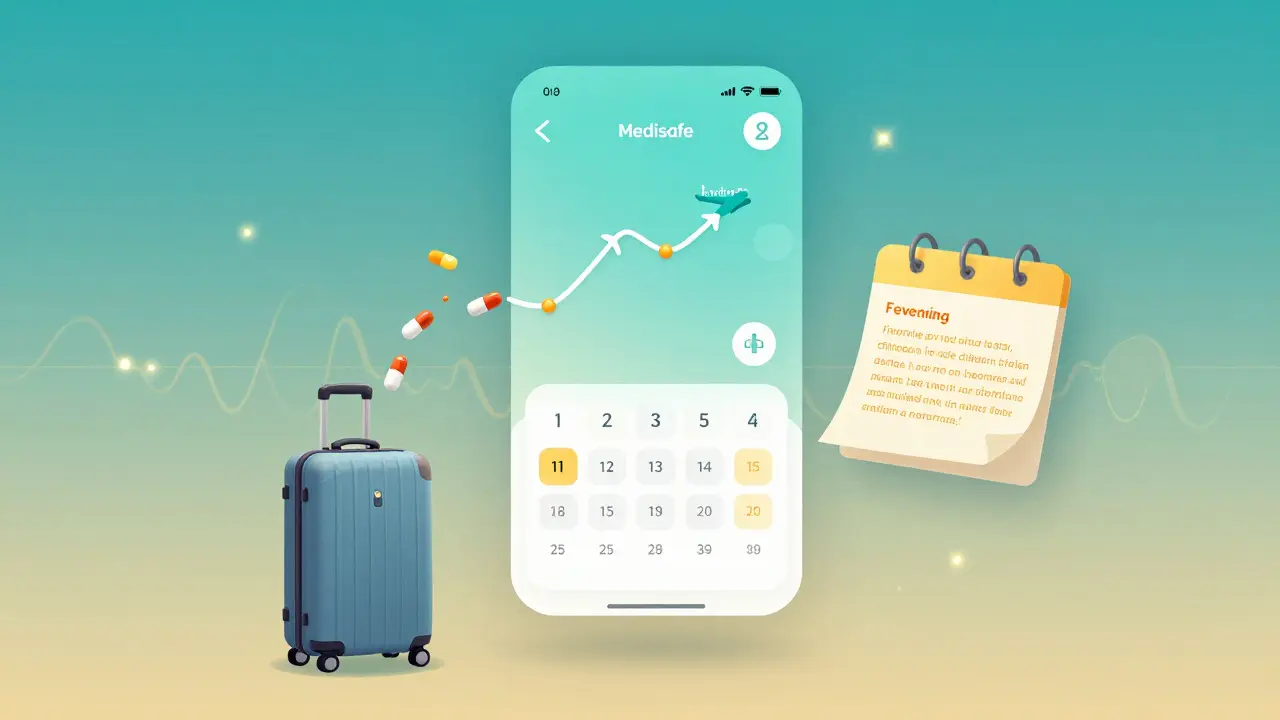
Not all health apps are created equal. Medisafe, rated 4.7 out of 5 on the App Store with over 12,000 reviews, syncs with your flight itinerary and adjusts alarms automatically. It sends alerts in local time and even reminds you to eat before taking Malarone.Another tool gaining traction is the WHO’s new Travel Health Tracker, still in pilot testing. It integrates with airline apps to detect time zone changes in real time. But right now, Medisafe is your best bet.
What to Do If You Miss a Dose
If you miss a dose of Malarone and you’re still in a malaria zone, take it as soon as you remember. But if it’s been more than 12 hours, skip it and resume your schedule. Don’t double up. Then, keep taking it for at least 4 more weeks after you leave the risk area. The CDC is clear: one missed dose in a high-risk zone means you’re not protected anymore.For HIV meds, it depends on the drug. If you’re on dolutegravir and miss by 8 hours, take it as soon as you can. If you’re on a protease inhibitor and miss by 6 hours, call your doctor. Don’t wait. A single missed dose can trigger resistance.
Why Most Travelers Fail
The biggest mistake? Thinking jet lag is just about sleep. It’s not. It’s about your liver, your stomach, your circadian rhythm-all of which affect how your body absorbs drugs. Eating at the wrong time, sleeping through alarms, drinking alcohol to “help” with jet lag-all of it interferes.Another issue: pharmacies abroad. In rural areas of Southeast Asia or Africa, the same drug might be sold under a different name. Or the dosage might be wrong. Always carry your original prescription bottle and a doctor’s note in English.
And don’t trust online forums for medical advice. A Reddit post saying “I took my pill at midnight and it was fine” doesn’t mean it’s safe for you. Your drug, your body, your schedule-those are unique.
The Future Is Coming
New long-acting injectables like cabotegravir/rilpivirine are changing the game. One shot every two months replaces daily pills. But as of June 2024, it’s only available in 17 countries. For now, daily dosing is still the norm.Researchers at the London School of Hygiene & Tropical Medicine are building AI tools that predict jet lag severity based on your sleep history, flight path, and even your age. These will soon suggest the exact best time to take your pill-not just based on time zones, but on your body’s internal clock. But that’s still a year away.
Until then, the rules are simple: know your drug, plan ahead, eat with your pill, and never skip the prep work.
Can I take antimalarials without food?
No-not if you want them to work. Drugs like Malarone and artemether-lumefantrine need fat to be absorbed properly. Taking them on an empty stomach can reduce effectiveness by up to 70%. Always take them with a meal or snack that contains oil, cheese, nuts, or butter.
What if I’m on multiple medications?
If you’re taking antiretrovirals and antimalarials together, check for interactions. Some antimalarials can affect how HIV drugs are processed by the liver. Always consult your doctor before combining them. Never adjust doses on your own.
Do I need to adjust my HIV meds for short trips?
If your trip is under 48 hours and you’re crossing fewer than 4 time zones, you can usually stick to your home schedule. But if you’re on a protease inhibitor and the time shift is more than 6 hours, adjust by 1-2 hours per day starting two days before you leave.
Is it safe to drink alcohol while taking antimalarials?
It’s not recommended. Alcohol can increase the risk of side effects like dizziness and nausea, especially with mefloquine or atovaquone-proguanil. It also disrupts sleep, which makes it harder to stick to your dosing schedule. Skip it during your trip.
Can I use a pill organizer for my travel meds?
Only if you’re sure about the timing. Pill organizers are fine for stable routines, but they don’t adjust for time zones. If you’re crossing multiple zones, use a digital app instead. If you must use a pill box, label each compartment with the destination time, not your home time.





Jenci Spradlin
January 8, 2026 AT 17:16