
Every time you pick up a packaged food item, you’re making a decision that could be life-or-death if you or someone you care about has a food allergy. In 2026, food labels are more detailed than ever-but that doesn’t mean they’re always clear. Hidden allergens, vague warnings like "may contain," and confusing ingredient lists still put millions at risk. The U.S. Food and Drug Administration (FDA) updated its guidance in January 2025, and these changes matter. They’re not just bureaucratic tweaks. They’re real shifts that affect what’s in your pantry, your child’s lunchbox, and your ability to eat safely.
What’s Actually on the Label Now?
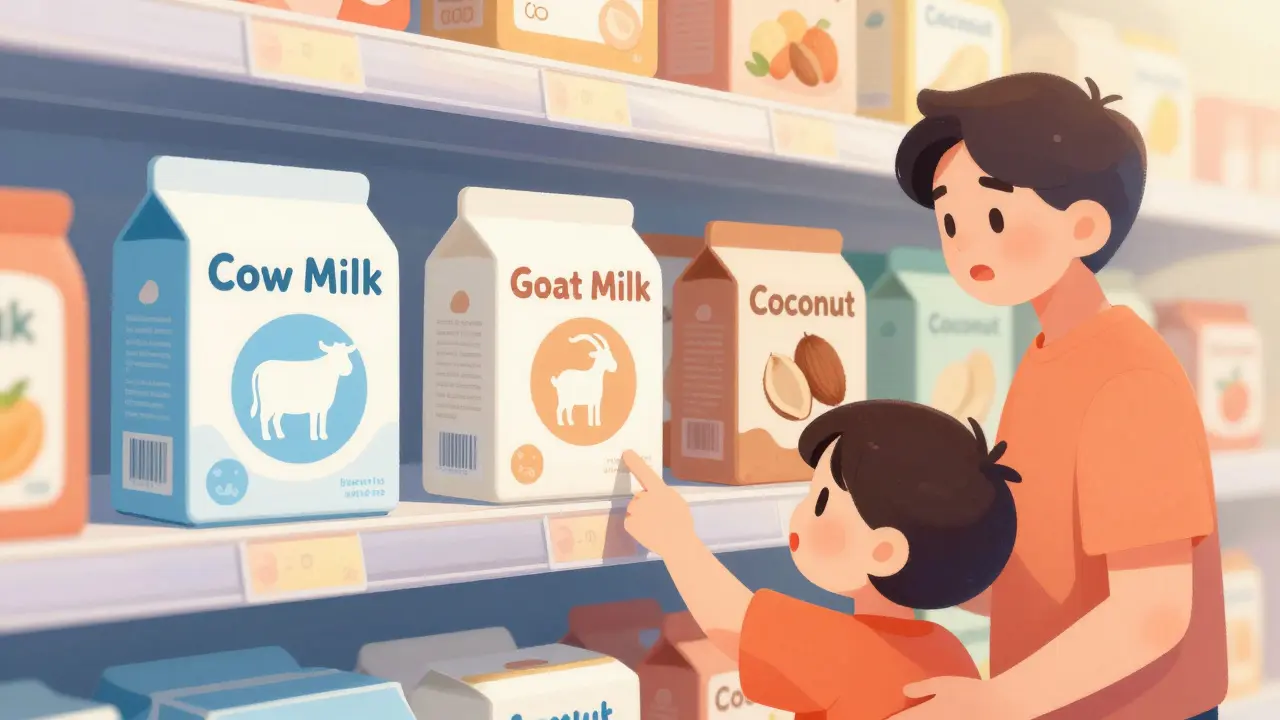
The nine major food allergens have been required on labels since 2004 under FALCPA: milk, egg, fish, crustacean shellfish, tree nuts, wheat, peanuts, soybeans, and sesame. But until 2025, the labels were often too vague. You’d see "milk" or "egg"-but never whether it came from a cow, goat, duck, or quail. That’s a huge problem. Someone allergic to cow’s milk might be fine with goat’s milk. But without clear labeling, they’d have no way to know. The same goes for eggs. A person allergic to chicken eggs might tolerate duck or quail eggs-but old labels didn’t tell them.
The 2025 FDA guidance changed that. Now, if a product contains milk, the label must say "goat milk," "sheep milk," or "cow milk." Same with eggs: "duck egg," "quail egg," etc. This isn’t optional. It’s mandatory for all FDA-regulated products. That includes snacks, meal replacements, infant formula, and even dietary supplements. It doesn’t apply to meat or poultry-that’s under USDA rules-but for everything else, specificity is now the rule.
Coconut Isn’t a Tree Nut Anymore
For years, coconut was lumped in with tree nuts on food labels. Many people with peanut or almond allergies avoided coconut out of caution. But coconut isn’t a tree nut. It’s a fruit. And for the 0.04% of Americans with a true coconut allergy, it was never a cross-reactive issue. Meanwhile, millions of people with tree nut allergies could safely eat coconut-but they didn’t know that.
The 2025 update removed coconut from the tree nut list. Now, if a product contains coconut, it must be labeled as "coconut," not "tree nuts." This reduces unnecessary fear and helps people make smarter choices. It also cuts down on wasted food-stores used to throw out products with "may contain tree nuts" warnings just because coconut was listed. Now, those products can stay on shelves for people who can safely eat them.
Shellfish Got a Tighter Definition
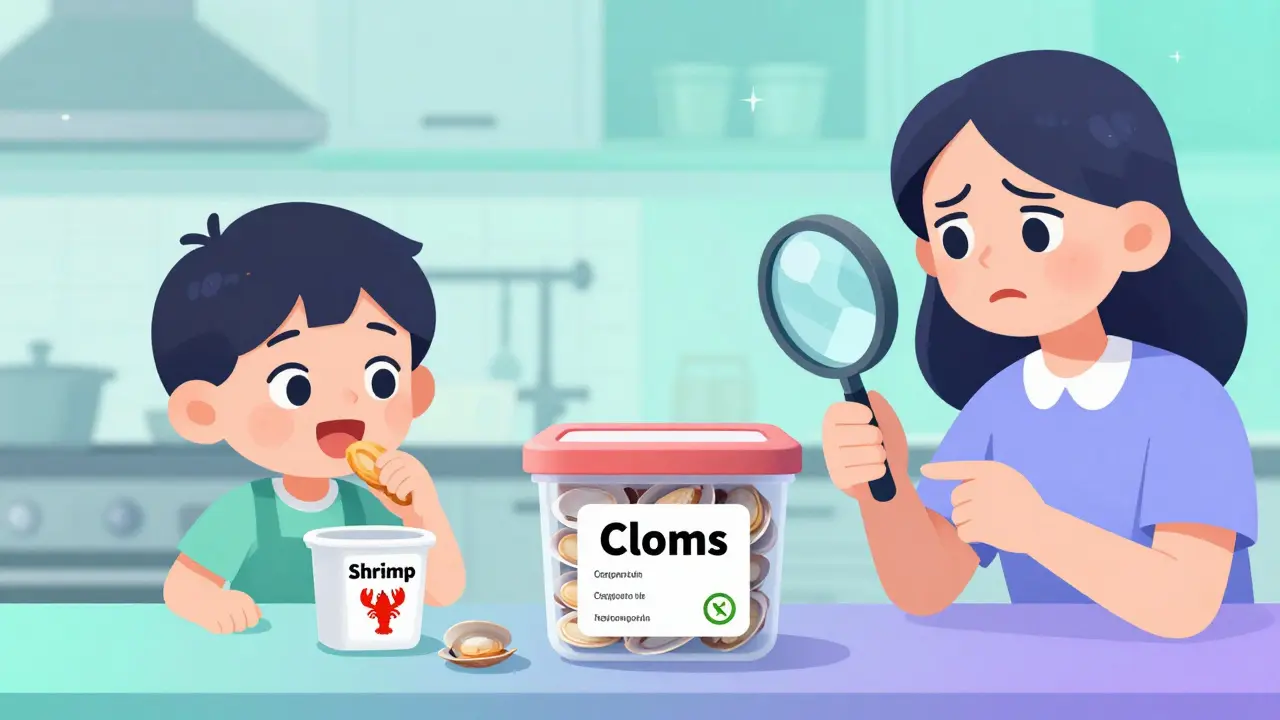
"Shellfish" used to mean everything from shrimp to oysters. But they’re biologically different. Crustaceans like shrimp, crab, and lobster share proteins that trigger allergic reactions. Mollusks like clams, oysters, scallops, and mussels? Different proteins. Some people are allergic to shrimp but can eat oysters. Others are the opposite.
The new guidance now limits "shellfish" on labels to crustaceans only. Mollusks are no longer covered under the major allergen list. That means if a product contains oysters or clams, the label doesn’t have to say "shellfish" at all. It might say "clam" in the ingredient list-but it doesn’t have to. And that’s dangerous. About 1.5 million Americans have mollusk allergies. They’re now flying under the radar. There’s no mandatory warning. No "Contains" statement. No alert. Just silence.
"Free-From" vs. "May Contain"-No More Mixed Messages
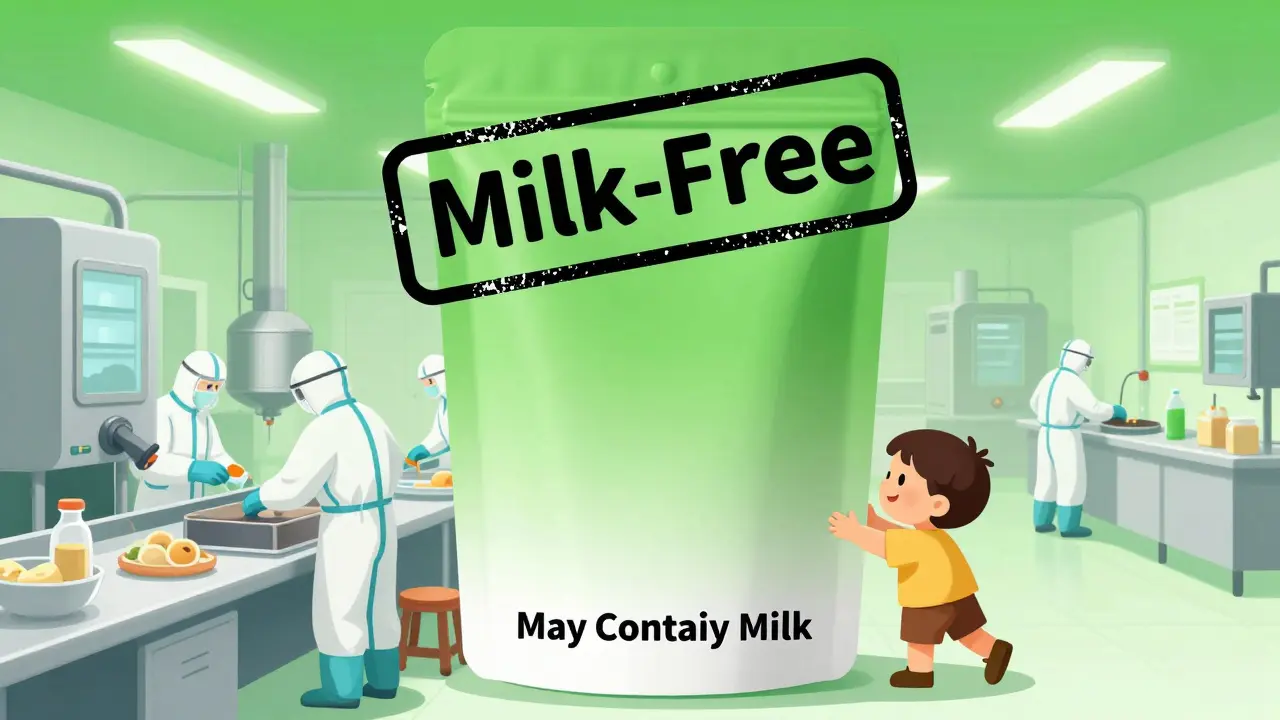
Have you ever seen a product that says "Milk-Free" at the top… but then has a tiny "May contain milk" on the side? It’s confusing. It’s misleading. And it’s dangerous.
The FDA now says: you can’t do both. If a product claims to be "free from" a major allergen, it cannot also carry a voluntary "may contain" warning for that same allergen. Why? Because it undermines trust. If a label says "no milk," consumers assume it’s safe. If it then says "may contain milk," that assumption is broken. The FDA says if you’re going to claim it’s free of an allergen, you have to prove it. That means strict controls in production to prevent cross-contact. No more half-measures.
This change is a win for safety. It forces manufacturers to choose: either make a truthful free-from claim with full controls, or don’t make the claim at all. It also helps people who rely on these labels every day. Parents of kids with severe allergies can now trust that "dairy-free" means what it says.
What About Cross-Contact?
Cross-contact happens when a food that doesn’t contain an allergen gets contaminated by accident. Maybe the same conveyor belt was used for peanut butter cookies, then for crackers. Maybe a spoon used for soy sauce was wiped with a towel and then used for gluten-free pasta. It’s invisible. It’s common. And it’s a major cause of allergic reactions.
The FDA still doesn’t require manufacturers to label for cross-contact. "May contain peanuts" is still voluntary. But now, if a company chooses to use it, the statement must be truthful. You can’t say "may contain peanuts" just to cover your bases if your facility has no peanuts anywhere. The FDA says those statements can’t be misleading. That means if you’re using a dedicated peanut-free line, you shouldn’t be putting "may contain" on the label.
But here’s the gap: there’s no standard for how much contamination triggers a warning. One company might say "may contain" for 1 part per million. Another might wait until 10 parts per million. There’s no science-backed threshold. So consumers are left guessing. That’s why some experts say the real solution is better manufacturing controls-not more warning labels.
What’s Missing? Mollusks, Gluten, and Beyond
The nine allergens cover about 90% of reactions. But they don’t cover everything. Mollusks are the biggest blind spot now. There are also allergies to fruits, seeds, spices, and even food additives like sulfites. The FDA released a separate guidance in January 2025 called "Evaluating the Public Health Importance of Food Allergens Other Than the Major Food Allergens." It’s a framework for deciding which allergens might be added next.
Gluten isn’t on the list. Why? Because it’s not an allergen-it’s a trigger for celiac disease, which is autoimmune, not allergic. But people with celiac still need clear labeling. The FDA requires gluten-free labeling under separate rules. That’s why you’ll see "gluten-free" on products even though gluten isn’t a major allergen.
Other allergens under review include mustard, celery, and lupin. The EU already requires these to be labeled. The U.S. is watching. If evidence grows, they could be added. But for now, if you’re allergic to mustard or sesame (yes, sesame was added in 2023), you have to read labels carefully. Sesame is now required to be labeled as "sesame" or "sesame seeds." No more hiding it as "natural flavors."
Who’s Affected? The Numbers Don’t Lie
Approximately 32 million Americans have food allergies. That’s 1 in 10 adults and 1 in 13 children. Milk allergies affect 4.5 million people. Egg allergies? 2 million. And sesame? Around 1.6 million since its 2023 inclusion. These aren’t small numbers. They’re families avoiding restaurants. Parents reading every label. Kids missing out on birthday cakes. The cost of a reaction? Emergency rooms, EpiPens, hospital stays. The emotional toll? Constant fear.
The new labeling rules aim to reduce that fear. But they can’t eliminate it. A label can’t tell you if a restaurant’s fryer was used for shrimp. It can’t tell you if a bakery used the same mixer for peanut butter and cookies. That’s why education matters as much as labeling. People need to know how to ask questions. How to check with manufacturers. How to recognize when a label might still be hiding risk.
What Should You Do?
Here’s what works right now:
- Always read the full ingredient list-not just the "Contains" statement. The allergen might be hidden in a less obvious ingredient.
- Look for specificity: Is it "cow milk" or just "milk"? Is it "shrimp" or "shellfish"? The new rules mean you should see more detail now.
- Don’t trust "free-from" claims unless you know the brand’s manufacturing practices. Even with the new rules, some companies still cut corners.
- Know your risk zones: Mollusks (oysters, clams) aren’t labeled. If you’re allergic, avoid them entirely unless you can confirm the source.
- Use apps and databases: Groups like Food Allergy Research & Education (FARE) have updated databases showing which brands follow the new rules.
If you’re a parent, teacher, or caregiver, teach kids to ask: "What kind of milk is this?" or "Is this shrimp or oyster?" Don’t assume. Always verify.
What’s Next?
The FDA says this guidance "may be updated as new scientific evidence emerges." That means more allergens could be added. Mustard, celery, and sesame are already under review. And pressure is growing to make cross-contact labeling mandatory-not voluntary. Some states, like California and New York, are already pushing for stricter rules.
Manufacturers are slowly catching up. Euromonitor predicts 75% of major U.S. food companies will adopt the new standards by 2027. But small producers? They’re struggling. Label changes cost $5,000 to $15,000 per product line. That’s why you might still see old labels on store shelves.
For now, the best defense is awareness. The rules are better. But they’re not perfect. Stay informed. Ask questions. And never stop reading the label.
Are food labels now required to say what type of milk is used?
Yes. As of January 2025, the FDA requires food labels to specify the animal source of milk. So instead of just "milk," labels must say "cow milk," "goat milk," "sheep milk," or another specific source. This helps people who are allergic to cow’s milk but can tolerate other types.
Is coconut still considered a tree nut on food labels?
No. As of the 2025 FDA guidance, coconut is no longer classified as a tree nut. It must now be labeled separately as "coconut." This change helps people with tree nut allergies who can safely eat coconut, and reduces unnecessary avoidance of coconut-containing products.
Do food labels have to warn about mollusks like oysters and clams?
No. The FDA now limits "shellfish" on labels to crustaceans only-shrimp, crab, and lobster. Mollusks like oysters, clams, scallops, and mussels are not required to be labeled as allergens. This creates a safety gap for the 1.5 million Americans with mollusk allergies, who must now rely on ingredient lists or direct manufacturer contact to identify risk.
Can a product say "milk-free" and also "may contain milk" on the same label?
No. The FDA now prohibits this. If a product claims to be free of an allergen like milk, it cannot also carry a voluntary "may contain" warning for the same allergen. This rule prevents misleading claims and ensures that "free-from" labels are backed by strict manufacturing controls.
Are all food products required to follow these new labeling rules?
No. The rules apply only to FDA-regulated products: packaged foods, infant formula, dietary supplements, and medical foods. USDA-regulated products like meat, poultry, and processed eggs are not covered. Also, alcohol beverages fall under TTB rules, which still don’t require allergen labeling. So always check the product type and manufacturer.




Tim Hnatko
March 6, 2026 AT 20:21