
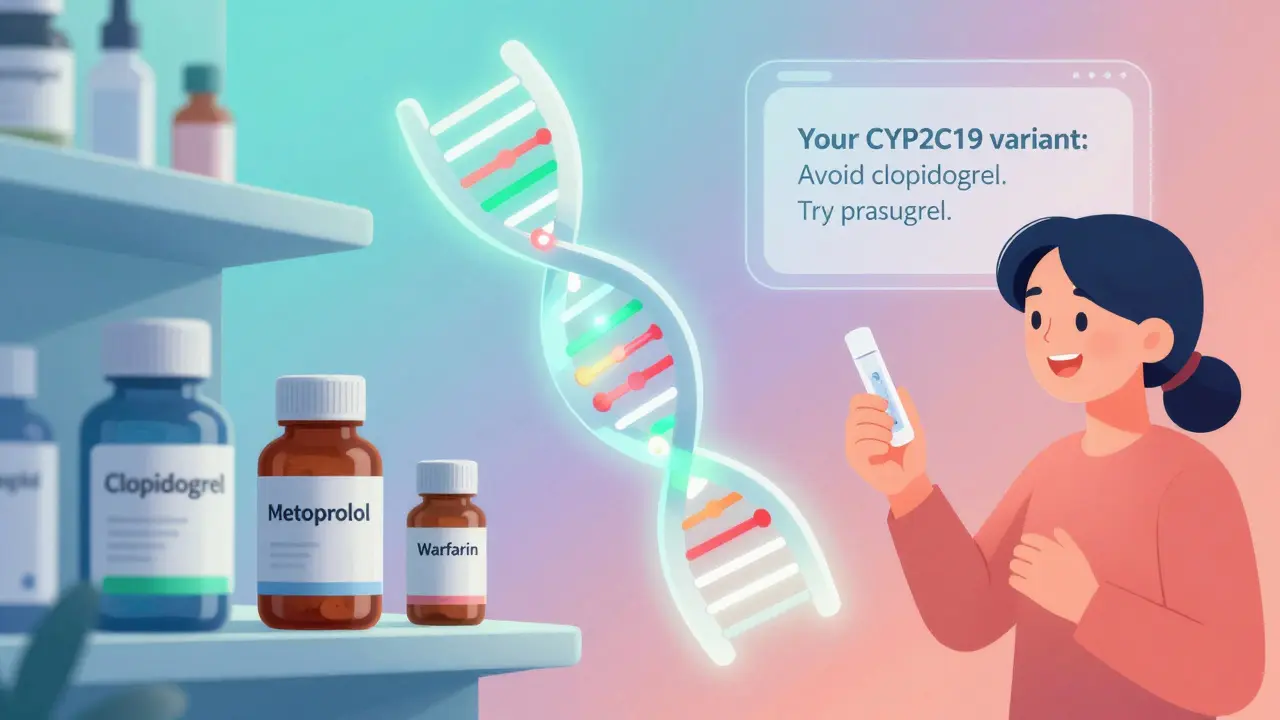
Imagine getting the right generic drug the first time-no trial and error, no dangerous side effects, no wasted months. That’s not science fiction anymore. Thanks to AI and pharmacogenomics, online pharmacies are starting to offer personalized generic recommendations based on your DNA. It’s not about fancy brand names. It’s about making the cheapest, most common drugs work better-for you.
What Is Pharmacogenomics, Really?
Pharmacogenomics sounds complicated, but it’s simple: it’s how your genes affect how your body handles drugs. Two people can take the same generic pill-say, clopidogrel for heart health-and one gets relief while the other has a stroke. Why? Because of a tiny variation in their CYP2C19 gene. That gene tells the liver how to break down the drug. If you’re a slow metabolizer, the drug doesn’t work. If you’re ultra-rapid, it builds up and causes bleeding. This isn’t rare. About 30% of people have at least one gene variant that changes how they respond to common medications. For drugs like warfarin, SSRIs, or statins, the difference between life and death can come down to a single DNA letter.How AI Makes This Work at Scale
Before AI, interpreting genetic tests took hours. Pharmacists had to cross-reference gene variants with clinical guidelines from CPIC (Clinical Pharmacogenetics Implementation Consortium). That’s slow, expensive, and not scalable. Now, AI tools like the one built with GPT-4 and CPIC data can read your genetic report in under two seconds and tell you: "Don’t use this generic clopidogrel. Try prasugrel instead. Your CYP2C19*2 variant means you won’t convert it to the active form." These systems don’t guess. They use retrieval-augmented generation (RAG), meaning they pull exact rules from trusted databases like PharmGKB and CPIC. They don’t invent answers. They just make the science faster and clearer. A 2024 study in JAMIA showed these AI tools were 89.7% accurate in interpreting genetic results-better than human pharmacists on average. And they explain things in plain language. Instead of "rs4244285 SNP," you get: "Your body doesn’t activate this drug well. Here’s what to take instead."Why This Matters for Generic Drugs
Generic drugs are cheaper because they’re copies of brand-name drugs. But they’re not all the same. Different manufacturers use different fillers and coatings. For most people, that doesn’t matter. For people with genetic differences? It can be everything. An AI-powered online pharmacy doesn’t just sell you the cheapest version of metoprolol. It checks your gene profile first. If you’re a CYP2D6 poor metabolizer, it recommends a different beta-blocker-maybe bisoprolol-because metoprolol could build up and slow your heart too much. It’s not about cost anymore. It’s about safety and effectiveness, even for generics. In 2023, Mayo Clinic used AI-guided PGx to cut adverse drug events by 22% in cardiac patients. Most of those patients were on generic medications. The AI didn’t change the drug class. It changed the right drug for your genes within that class.
How It Works in an Online Pharmacy
Here’s the real-world flow:- You order a genetic test kit from the pharmacy’s partner lab (like OneOme or Color Genomics).
- You mail back your saliva sample.
- Within 10-14 days, your report lands in your secure portal.
- The AI analyzes your genes against 150+ drug-gene pairs from CPIC guidelines.
- You get a personalized list: "These 12 generic medications are safe for you. These 8 could be dangerous. Here are better alternatives."
- When you refill a prescription, the pharmacy’s system auto-checks your profile before dispensing.
What You Can Do Today
You don’t need to wait for this to become mainstream. Here’s how to get started now:- Look for online pharmacies that partner with FDA-cleared PGx testing companies. GeneSight Psychotropic was the first AI-PGx tool cleared by the FDA in 2023.
- Ask if they offer AI-based drug matching with your genetic results. Not all do.
- Don’t trust a pharmacy that offers genetic testing but doesn’t explain how the results affect your meds.
- Start with high-risk drugs: antidepressants, blood thinners, painkillers, statins.
The Risks and Limits
This isn’t magic. AI can make mistakes. In the same JAMIA study, 3.2% of AI responses had clinically significant errors-like missing a rare variant that could cause opioid overdose. That’s why no system is fully autonomous. Human pharmacists still review high-risk cases. Biggest problem? Data bias. Over 78% of genetic data in global databases comes from people of European descent. If you’re of African, Asian, or Indigenous ancestry, your results might be less accurate. The NIH just launched a $125 million initiative in 2024 to fix this. Also, AI can’t read raw DNA. You need a processed genetic report. That means you still need to get tested by a certified lab-not a 23andMe-style consumer kit. Those don’t have the right gene coverage for drug response.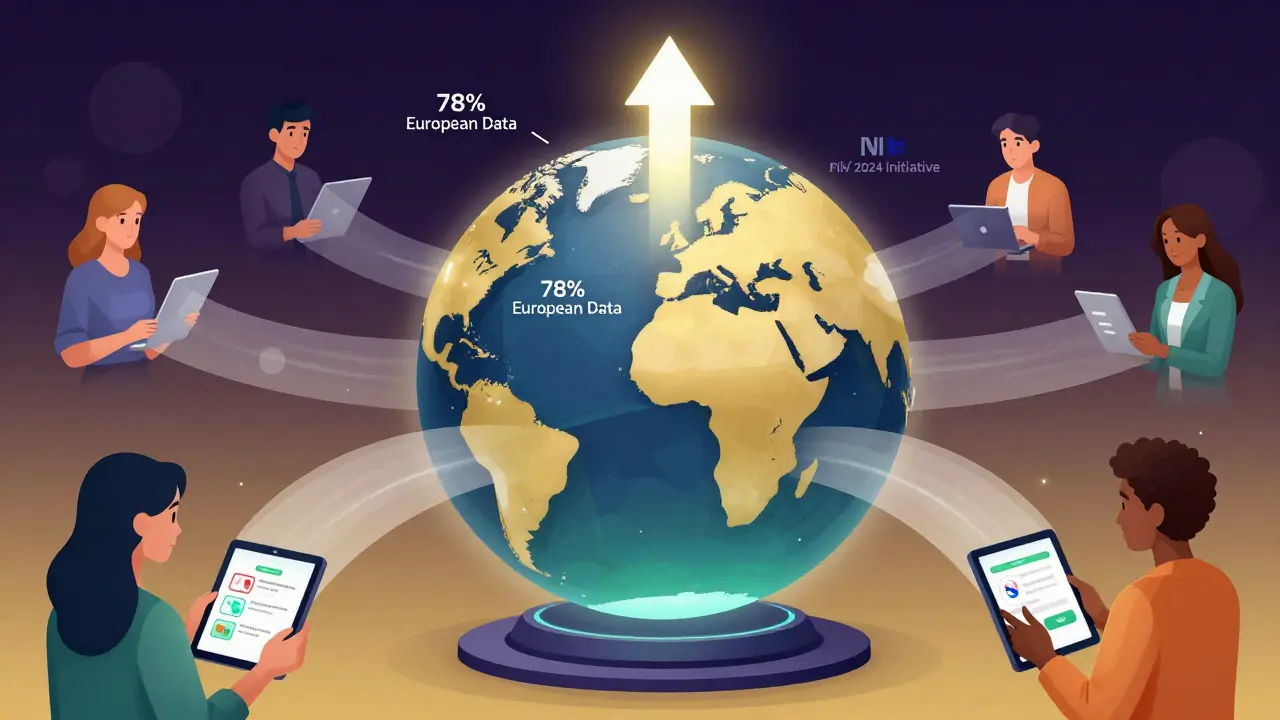
Who Benefits Most?
This isn’t just for people with complex conditions. It helps anyone who:- Has had bad reactions to common meds
- Takes multiple prescriptions
- Is on long-term painkillers or antidepressants
- Has family history of drug-related hospitalizations
- Wants to avoid wasting money on pills that don’t work
The Future: What’s Coming by 2027
By 2027, AI-PGx won’t just tell you which generic to take. It’ll combine your genes with your metabolism, liver function, and even gut microbiome data. Think of it as a full-body drug response map. DeepMind’s AlphaPGx, launching in 2025, will simulate how drugs bind to enzymes at the atomic level. That means predicting reactions before they happen-even for new generics not yet on the market. The goal? Reduce medication-related hospitalizations by 15-20% by 2030. That’s 800,000 fewer ER visits a year in the U.S. alone.Final Thought: Trust, But Verify
AI isn’t replacing your pharmacist. It’s giving them superpowers. The best online pharmacies now use AI to catch mistakes humans might miss. But you still need to ask questions. If a pharmacy offers "personalized generics" but won’t show you the CPIC guidelines behind their recommendations, walk away. If they say their AI "learns from your usage," that’s a red flag. Real AI uses fixed, peer-reviewed databases-not your personal data to train models. This isn’t about selling more pills. It’s about making sure the right pill reaches the right person. For the first time, generic drugs can be as precise as branded ones. And that changes everything.Can AI really recommend generic drugs based on my genes?
Yes. AI systems like the one built with GPT-4 and CPIC guidelines can analyze your genetic test results and recommend which generic medications are safe and effective for you. They match your gene variants-like CYP2D6 or CYP2C19-to known drug responses. This isn’t theoretical; it’s being used in hospitals and now starting to appear in online pharmacies.
Do I need to get a genetic test to use this service?
Yes. You need a clinical-grade pharmacogenomic test that looks at key drug-metabolizing genes. Consumer tests like 23andMe don’t cover enough of the right genes. Look for tests from FDA-cleared labs like OneOme, Color Genomics, or GeneSight. Once you have your report, you can upload it to participating online pharmacies.
Are AI-generated recommendations reliable?
Most are, but not perfect. The best systems are 89-90% accurate, based on peer-reviewed studies. However, they can miss rare variants or misinterpret complex gene interactions. Always have a pharmacist review the AI’s suggestions, especially for high-risk drugs like blood thinners or antidepressants. Never replace professional advice with an AI report alone.
Is this available at any online pharmacy?
No. This is still emerging. Only a small number of online pharmacies have integrated AI-PGx systems. Look for those partnered with major health systems like Mayo Clinic or companies like InterSystems. Check if they mention CPIC guidelines, EHR integration, or FDA-cleared tools. If they don’t, they’re likely just marketing the term.
What if I’m not of European descent?
Current genetic databases are heavily skewed toward European ancestry-78% of data comes from this group, even though they make up only 16% of the global population. This means AI recommendations may be less accurate for people of African, Asian, Indigenous, or Latin American descent. The NIH is funding new research to fix this, but for now, be cautious. Ask the pharmacy if their AI system includes diverse population data.
Will this lower my medication costs?
Not directly. But it can save you money long-term. By avoiding ineffective or dangerous drugs, you reduce wasted prescriptions, ER visits, and hospital stays. One study found AI-PGx reduced adverse drug events by 22% in cardiac patients. Fewer complications mean fewer costly medical bills. Plus, you won’t be paying for pills that don’t work.



Mussin Machhour
December 26, 2025 AT 02:48