
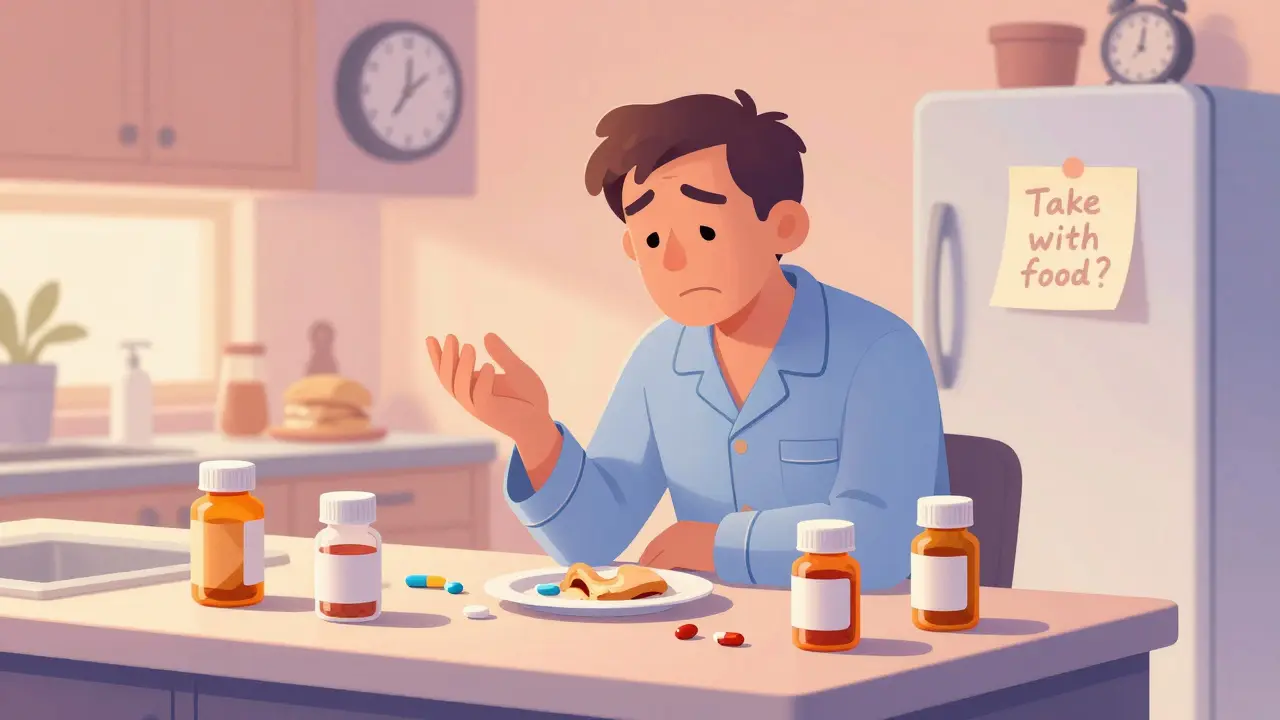
Every year, medication adherence fails for nearly half of all patients taking long-term prescriptions. It’s not laziness. It’s not ignorance. It’s a tangled mix of real, everyday problems that make taking your medicine feel impossible-even when you know it matters.
Think about it: you’re told to take a pill every morning. Then another at lunch. Then two more at night. One of them needs to be taken on an empty stomach. Another can’t be mixed with dairy. The bottle has tiny print. The cost is $80 a month. You work swing shifts. You forgot what the doctor said about why you need it. And now, after three weeks, you’re skipping doses just to make it through the week.
This isn’t rare. It’s normal. And it’s costing lives.
Forgetfulness Is the #1 Reason People Skip Pills
More than 40% of patients over 59 say they miss doses simply because they forget. That’s not a personality flaw. It’s a human limitation. Our brains aren’t wired to remember 5-7 different pills at different times every day, especially when nothing feels different when you take them.
One man in Sydney took his blood pressure meds for six months. He never missed a day-until his wife went into hospital. For two weeks, he was juggling appointments, meals, and sleep. He started taking his pills at random times. His blood pressure spiked. He didn’t realize why until his pharmacist asked: "When was the last time you took your amlodipine?"
Forgetfulness hits hardest with complex regimens. A 2023 meta-analysis found that patients taking four or more doses a day had only a 51% adherence rate. Those on once-daily pills? 79%. It’s not about willpower. It’s about design.
Cost Is a Silent Killer
One in five new prescriptions are never filled because of price. Not because the patient doesn’t care. Because they can’t afford it.
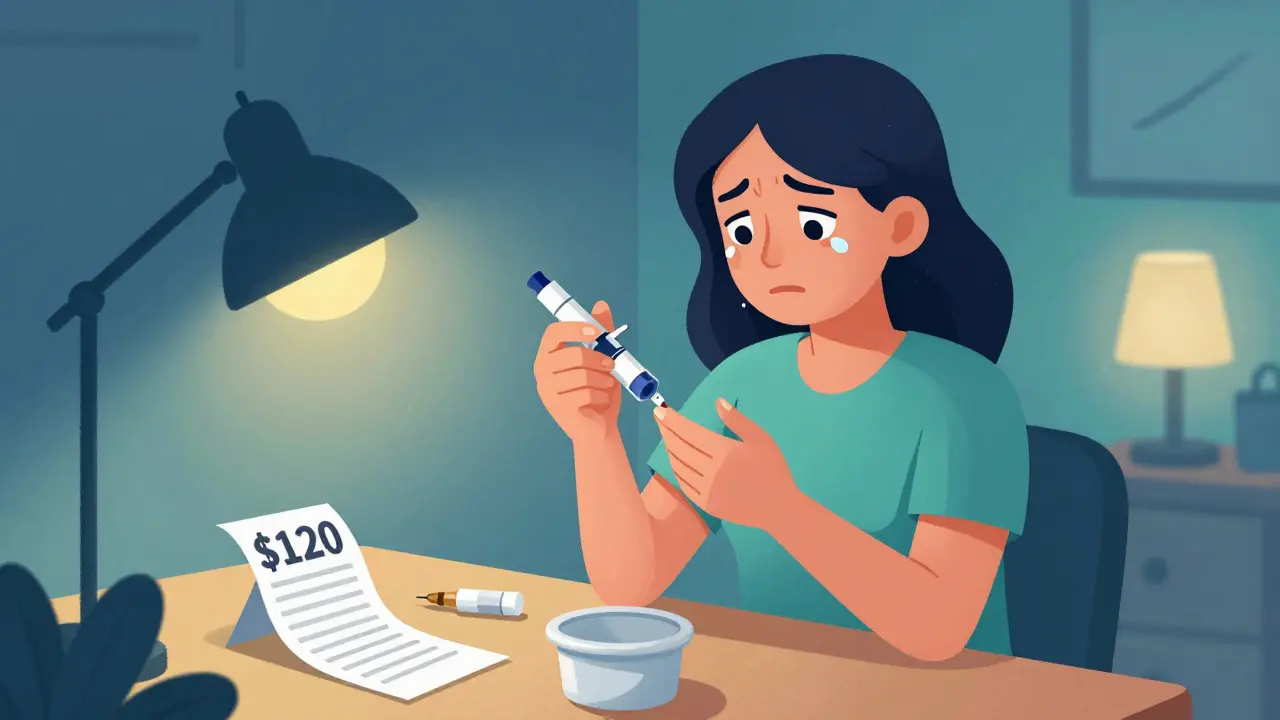
A diabetic patient in Adelaide told her pharmacist she was cutting her insulin in half. "I take half the dose, and it lasts twice as long," she said. She wasn’t being reckless. She was surviving. Her prescription cost $120 a month. Her part-time job paid $1,800. Rent was $650. She chose between insulin and groceries.
Studies show 50% of patients cite cost as their top barrier. The CDC says 20-30% of new scripts go unfilled because of price. And it’s not just the drug. It’s the copay, the travel to the pharmacy, the time off work. For low-income patients, the cost isn’t just financial-it’s logistical.
Too Many Pills, Too Many Rules
Polypharmacy isn’t just a medical term. It’s a daily nightmare.
For every extra pill a person takes, their chance of missing doses goes up by 16%. A patient on three medications has a 48% chance of nonadherence. On five? That jumps to 64%. And it’s not just the number-it’s the timing. One pill before breakfast. One after. One at bedtime. One with food. One without. One that can’t be crushed. One that needs to be swallowed upright.
Reddit user "MedManager87" wrote: "I have 5 different meds. 3 need different times. I miss doses twice a week because my work schedule changes." That’s not a failure. That’s a system failure.
Doctors often prescribe these regimens without realizing how hard they are to follow. A 15-minute visit isn’t enough to explain how to take five pills in five different ways. And patients? They nod along. They don’t want to seem difficult. So they go home confused-and stop taking them.
Confusing Instructions and Poor Communication
Medication labels are written for pharmacists, not patients.
One woman with diabetes said her insulin pen instructions had print so small she couldn’t read the dosage. She overdosed twice. Another patient didn’t know his blood pressure pill was meant to be taken at night-not morning-because his doctor never told him. His readings got worse. He thought the medicine wasn’t working.
Eighty-four percent of diabetic patients say they received inadequate counseling. That’s not just a missed opportunity. It’s dangerous.
When patients don’t understand why they’re taking a drug, they assume it’s not important. If you don’t know why you need to take something, skipping it feels harmless. Especially when you feel fine.
Doubts About Need and Fear of Side Effects
It’s not just practical. It’s psychological.
Forty-seven percent of nonadherence comes from doubts about whether the medicine is even necessary. Thirty-eight percent comes from fear of side effects. Patients look at their pill bottles and think: "I feel fine. Why am I taking this?"
One man stopped his statin because he read online that it could cause muscle pain. He didn’t tell his doctor. He just stopped. Six months later, he had a heart attack.
Another woman with high cholesterol refused her medication because she believed "natural remedies" were better. She didn’t trust the science. She didn’t trust the system. And she didn’t feel heard.
These aren’t irrational fears. They’re responses to poor communication. When patients aren’t given clear, honest, personalized reasons for their treatment, they fill the silence with their own assumptions-and often, those assumptions are wrong.

Age, Tech, and the Digital Divide
Younger adults (18-34) miss doses more often than older ones. Why? They’re less likely to have chronic conditions, so they don’t see the long-term risk. They’re also more likely to be juggling jobs, kids, and life-and medication doesn’t fit.
Older adults (65+) struggle too. But for different reasons. They’re more likely to have multiple prescriptions. They’re more likely to have vision or memory issues. And they’re less likely to use apps or digital reminders.
A 2023 study found 42% of patients over 65 feel uncomfortable with digital tools like pill reminder apps. They don’t trust them. They don’t know how to use them. They’re afraid of making a mistake.
But here’s the twist: the same study showed that with just three training sessions, most older adults could use these tools successfully. The problem isn’t age. It’s access. And support.
What Actually Works to Fix This
There’s no magic bullet. But there are proven fixes.
Simplify the regimen. One pill a day. Combination pills. Long-acting injectables. These cut adherence barriers in half.
Automate refills. Mail-order 90-day supplies increase adherence by 15-20%. No more running out. No more trips to the pharmacy.
Pharmacist-led sync programs. When all your meds are due on the same day each month, you’re 18% more likely to take them. That’s not a small win. That’s life-changing.
Structured counseling. A 20-minute conversation with a pharmacist or nurse-where the patient is asked, "What’s stopping you?"-boosts adherence by 25%.
Cost assistance. Generic alternatives. Patient assistance programs. Coupons. These aren’t luxuries. They’re necessities.
The best solutions don’t just tell patients to remember. They change the system so remembering isn’t the problem.
It’s Not the Patient’s Fault
We blame patients. We say they’re noncompliant. Unmotivated. Disorganized.
But the data doesn’t support that. The real problem? A system designed for convenience, not care.
Doctors are rushed. Pharmacists are understaffed. Labels are confusing. Costs are high. Pills are complicated. And patients? They’re left to figure it out alone.
Medication adherence isn’t about discipline. It’s about design. It’s about communication. It’s about access. It’s about dignity.
When we fix the system-not the patient-we don’t just improve adherence. We save lives. Every year, 125,000 Americans die because someone skipped a pill. We can change that. But only if we stop blaming the person-and start fixing the system.






Kitty Price
December 16, 2025 AT 09:07