
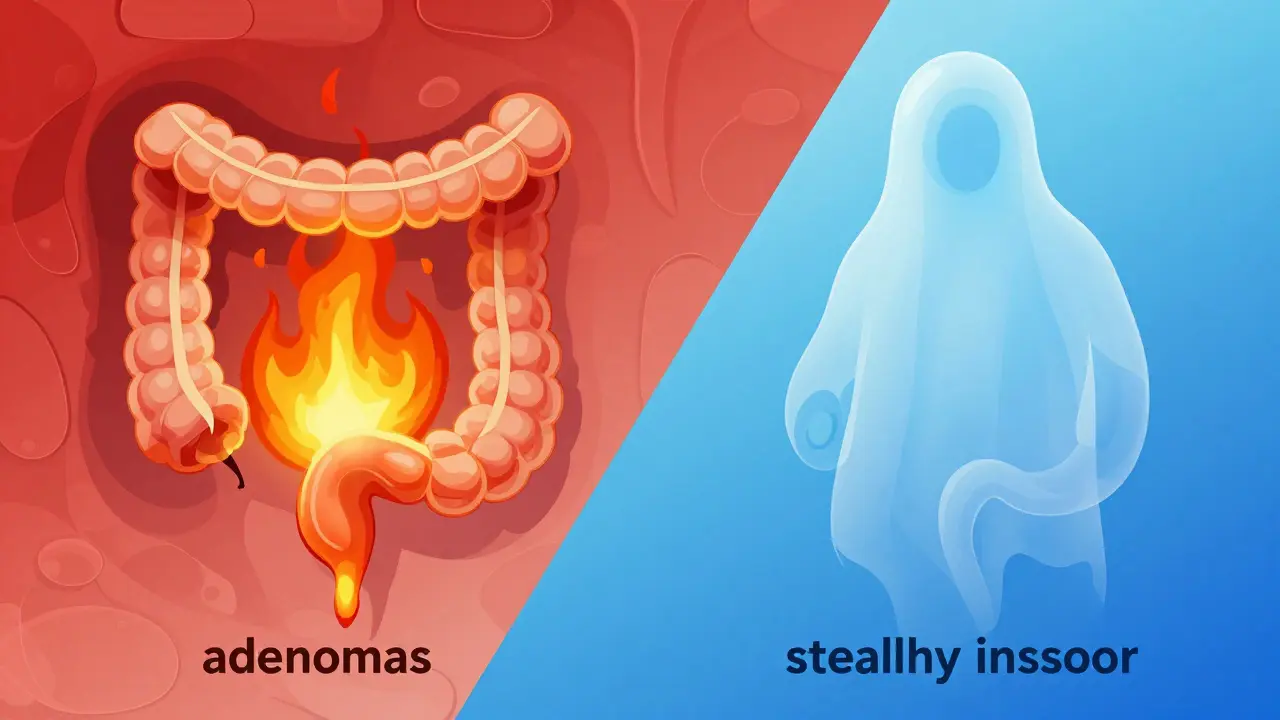
Finding out you have a polyp after a colonoscopy can feel alarming, but here is the reality: about 30-50% of adults will develop at least one by age 60. Most of these growths are harmless, but some are ticking time bombs. The big question isn't just whether you have a polyp, but what colorectal polyps actually are and which pathway they take toward potentially becoming cancer.
When your doctor talks about "adenomas" or "serrated lesions," they are describing two completely different biological roadmaps. One is like a slow-burn fire that's easy to spot, while the other is more like a stealthy intruder that hides in plain sight. Understanding the difference helps you understand why your doctor might suggest a follow-up in three years instead of five.
The Basics of Adenomatous Polyps
Think of Adenomas is the most common type of precancerous polyp, accounting for roughly 70% of all cases. These are essentially abnormal growths of the glandular lining in your colon. They follow what doctors call the chromosomal instability pathway, often triggered by mutations in the APC gene.
Not all adenomas are created equal. They are usually grouped by how they look under a microscope:
- Tubular Adenomas: These are the most frequent (about 70% of adenomas). They grow in tube-like patterns and generally have the lowest risk of turning into cancer.
- Tubulovillous Adenomas: A hybrid mix of tubular and villous growth. These are slightly more concerning than purely tubular ones.
- Villous Adenomas: These are the red flags. They have a flat, carpet-like growth pattern and are significantly more likely to be malignant. In fact, villous components can increase cancer risk by 25-30% compared to tubular ones of the same size.
Size matters here. If an adenoma is smaller than 0.5 centimeters, the chance of it containing cancer is less than 1%. However, once they cross the 1 centimeter mark, that risk jumps to 10-15%.
The Stealthy Side: Serrated Lesions
While adenomas are the "classic" precancerous polyps, Serrated Lesions is a group of polyps characterized by a saw-tooth appearance under the microscope. They don't follow the same genetic path as adenomas; instead, they often involve BRAF mutations. These account for roughly 20-30% of all colon cancers.
There are three main types you'll see on a pathology report:
- Hyperplastic Polyps: Usually found in the lower colon and generally benign. Most of the time, these aren't a cause for concern.
- Sessile Serrated Adenomas/Polyps (SSA/Ps): These are the dangerous ones. They are often flat, pale, and hide in the proximal colon (the beginning part of your large intestine). Because they don't stick out like a mushroom, they are much harder for a doctor to spot during a procedure.
- Traditional Serrated Adenomas (TSAs): These are rarer but still carry a high risk of progression to cancer.
The real danger of SSA/Ps is their "insidious" nature. A 2016 study in Colorectal Disease found that SSA/Ps have a malignant potential almost identical to conventional adenomas, with about 13% showing high-grade dysplasia or carcinoma.
Comparing the Two Pathways
If you're trying to wrap your head around the difference, it helps to look at how they behave side-by-side. Adenomas are often more "obvious" and follow a predictable growth pattern, whereas serrated lesions can be flat and elusive.
| Feature | Adenomatous Polyps | Serrated Lesions (SSA/Ps) |
|---|---|---|
| Commonality | Very High (~70% of polyps) | Moderate (20-30% of cancers) |
| Visual Appearance | Often pedunculated (on a stalk) | Often sessile (flat/broad-based) |
| Primary Location | Distributed throughout colon | Predominantly Proximal Colon |
| Genetic Driver | APC gene mutations | BRAF mutations |
| Detection Difficulty | Easier (if pedunculated) | Harder (flat morphology) |

Why Detection is Such a Struggle
Imagine trying to find a mushroom in a forest-that's a pedunculated polyp. Now imagine trying to find a slightly different shade of green grass on a flat field-that's a sessile serrated lesion. This difference in shape is why the "miss rate" for sessile polyps can be as high as 6% during standard colonoscopies.
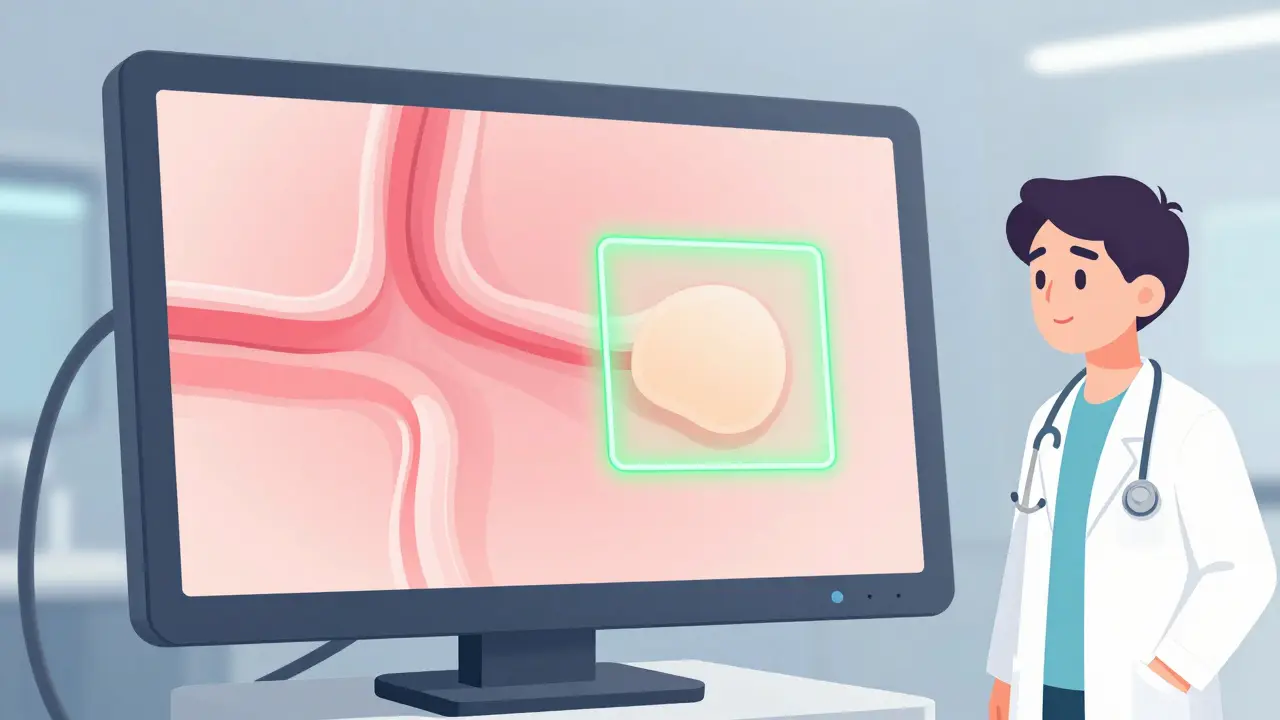
Because SSA/Ps often live in the cecum and ascending colon, they are tucked away in the deepest parts of the colon. This is why the industry is moving toward AI-assisted tools. Systems like GI Genius use machine learning to highlight suspicious areas in real-time, which has been shown to increase adenoma detection by 14-18%.
From Discovery to Removal
The goal is always the same: get the polyp out. A Polypectomy is the standard gold-standard treatment. For smaller adenomas (under 2cm), the success rate is incredibly high, around 95-98%. However, when dealing with sessile serrated lesions larger than 2cm, that success rate drops to 80-85% because the edges are so hard to define.
If you've had a polyp removed, your doctor will look for two things: was it removed completely, and did it already contain cancer cells? If the margins are "clear," you've successfully stopped a potential cancer in its tracks. But the journey doesn't end there. Depending on the type and number of polyps, you'll enter a surveillance cycle. For instance, US guidelines often suggest a 3-year check-up for SSA/Ps 10mm or larger, though some European doctors lean toward a 5-year interval.
What to Watch For
Here is the tricky part: polyps usually don't have symptoms until they are quite large or have already become cancerous. You can't simply "feel" a polyp. However, some people do report:
- Rectal bleeding (seen in 30-40% of symptomatic cases).
- Iron deficiency anemia caused by slow, invisible blood loss.
- Noticeable changes in bowel habits.
Since you can't rely on symptoms, regular screening is the only real safeguard. Recent data from the National Cancer Institute shows that colon cancer is actually dropping in people over 55 because we're getting better at removing these polyps early. Strangely, it's rising in people under 50, which is why the conversation around early screening is becoming so urgent.
Do I have cancer if I have adenomas or serrated polyps?
No. These are precancerous, not cancerous. This means they have the potential to become cancer over time, but they are not cancer themselves. Most people who have these polyps removed will never actually develop colorectal cancer.
Why are serrated polyps considered more "dangerous" to detect?
Serrated polyps, specifically sessile serrated adenomas (SSA/Ps), are often flat and pale. Unlike some adenomas that grow on a stalk (like a mushroom), SSA/Ps blend into the colon wall and are typically located in the proximal colon, making them very easy for a gastroenterologist to overlook during a routine colonoscopy.
What is the difference between a hyperplastic polyp and an SSA/P?
While both are "serrated," hyperplastic polyps are generally benign and low-risk, especially when found in the lower rectum. SSA/Ps, on the other hand, are true precancerous lesions that require complete removal and regular follow-up surveillance because they can progress to malignancy.
How often do I need a colonoscopy after polyp removal?
This depends on the polyp's size, type, and number. For example, a small tubular adenoma might only require a check-up in 5-10 years. However, for SSA/Ps 10mm or larger, US guidelines often suggest a 3-year interval. Always follow your specific gastroenterologist's advice as they base this on your personal pathology report.
Can AI help find these polyps?
Yes. New AI-assisted systems, such as GI Genius, act as a second set of eyes for the doctor. They use algorithms to flag areas of the colon wall that look suspicious, which has been shown to increase the detection rate of adenomas by 14-18% in clinical trials.
Next Steps and Troubleshooting
If you've just received a pathology report and are feeling overwhelmed, start by looking for the words "margins clear." This means the doctor believes they got the whole thing. If the report mentions "villous features" or "high-grade dysplasia," don't panic, but do schedule a follow-up appointment sooner rather than later to discuss a tighter surveillance window.
For those with a family history of early-onset colorectal cancer, don't wait until 45 or 50. Because the "serrated pathway" and "adenomatous pathway" can be influenced by genetics, getting your first screen earlier can be the difference between a simple 15-minute polypectomy and a much more complex medical journey.






Sam Hayes
April 6, 2026 AT 00:43